How to Secure the Best Small Business Risk Support Without Losing Your Mind
Why Small Business Risk Support Can Make or Break Your Business
Small business risk support refers to the tools, programs, strategies, and expert guidance that help business owners identify, manage, and recover from threats to their operations.
Here’s a quick overview of what effective small business risk support looks like:
| Type of Support | What It Covers |
|---|---|
| Financial risk management | Cash flow, debt, revenue concentration |
| Operational support | Equipment failures, supply chain, HR issues |
| Cybersecurity protection | Data breaches, fraud, IT vulnerabilities |
| Disaster resilience planning | Business continuity, emergency funds, recovery |
| Insurance and risk transfer | Liability, property, business interruption coverage |
| Government and community programs | SBA loans, SCORE mentorship, local grants |
Running a small business means wearing every hat – finance, HR, tech, customer service, and more. Most days, risk management falls to the bottom of the pile.
But here’s the hard truth: only 30% of small business owners have a business continuity plan in place. And about 25% of businesses never reopen after a major disaster.
That’s not a statistic about bad luck. That’s a gap in preparation.
Risks don’t just come from threats. They can come from opportunities too – a new hire, a big client, rapid growth. Without a clear support system, even good news can create dangerous exposure.
For faith-driven entrepreneurs already stretched thin, this isn’t just a business problem. It’s a mission problem. When your business is your calling, protecting it is an act of stewardship.
This guide breaks down exactly how to build strong, practical risk support for your small business – without overwhelm and without losing your mind.
What is Risk Management and Why is it Essential?
At its heart, risk management is the practice of identifying and analyzing loss exposures and taking proactive steps to minimize the financial impact. It isn’t just about preventing bad things from happening; it’s about ensuring that when the unexpected occurs, your business has a soft place to land.
For a small business, risk management is essential because it:
- Saves Time in Decision-Making: When you have a plan, you don’t have to panic-search for solutions in the middle of a crisis.
- Increases Success Probability: Businesses that anticipate hurdles are more likely to clear them.
- Protects Your Mission: Whether you are providing a service or creating a product, risk management ensures your work continues.
According to the Business Resilience Guide: Reducing Risks and Building on Strengths, resilience isn’t just surviving a disaster—it’s about building on your existing strengths to reduce future vulnerabilities. We believe that every entrepreneur deserves managed risk support that allows them to focus on their calling rather than their fears.

The 6 Pillars of Small Business Risk Support
To effectively manage a business, we have to look at risks through two lenses: internal (things we can mostly control) and external (things that happen to us).
| Risk Category | Type | Examples |
|---|---|---|
| Internal | Operational, Financial | Faulty equipment, poor cash flow, employee turnover |
| External | Hazard, Strategic | Natural disasters, market shifts, new regulations |
We categorize these into six specific pillars to help you organize your small business risk support strategy.
1. Financial Risk
This involves anything that threatens your cash flow or capital. Common pitfalls include high debt-to-equity ratios (the general guideline is to stay below 40-50%) or relying too heavily on a single large customer. If that one client leaves, your revenue vanishes.
2. Strategic Risk
Strategic risks are often voluntarily assumed for greater returns—like expanding into a new market. However, if the market shifts or a competitor undercuts your pricing, the strategy can backfire. Proactive managed-strategic-support helps you evaluate these moves before you leap.
3. Reputational Risk
A single bad review or a public misunderstanding can tarnish years of hard work. For small businesses, reputation is heavily tied to online presence and customer service quality.
4. Hazard Risk
These are “acts of God” or accidents—building fires, storm damage, or an employee getting injured on the job. These are typically managed through insurance and safety protocols.
5. Operational Risk
Operational risks are the “gears” of your business grinding to a halt. This could be a server outage, a delivery van breaking down, or an administrative error that leads to a missed tax deadline. Improving your internal systems through managed-process-improvement is the best defense here.
6. Cybersecurity Risk
With 88% of small business owners feeling vulnerable to cyber-attacks, this is no longer just a “big tech” problem. Data breaches and fraud can be devastating for a small firm.
Proven Strategies for Financial and Strategic Risk Support
To handle financial risk, we recommend diversifying your client base and maintaining 3–12 months of emergency funds. Keep a close eye on your debt-to-equity ratio and ensure your accounting duties are separated (one person shouldn’t handle the books and the bank deposits) to prevent internal fraud.
For strategic risks, don’t go it alone. Use SWOT analysis (Strengths, Weaknesses, Opportunities, Threats) to vet every major decision. If you’re feeling overwhelmed by the technicalities, managed-process-improvement can help streamline your operations so you have the mental bandwidth to think strategically.
Navigating Cybersecurity and Operational Risk Support
Operational resilience starts with redundancy. If your delivery van breaks down, do you have a backup? If your main supplier closes, do you have a secondary contact?
In the realm of cybersecurity, the basics go a long way:
- Use multi-factor authentication (MFA).
- Backup your data off-site (cloud and physical).
- Train employees to recognize phishing emails.
If managing IT feels like a foreign language, leveraging managed-cybersecurity and managed-technology ensures your digital assets are protected by experts while you focus on growth.
A Step-by-Step Framework to Identify and Prioritize Risks
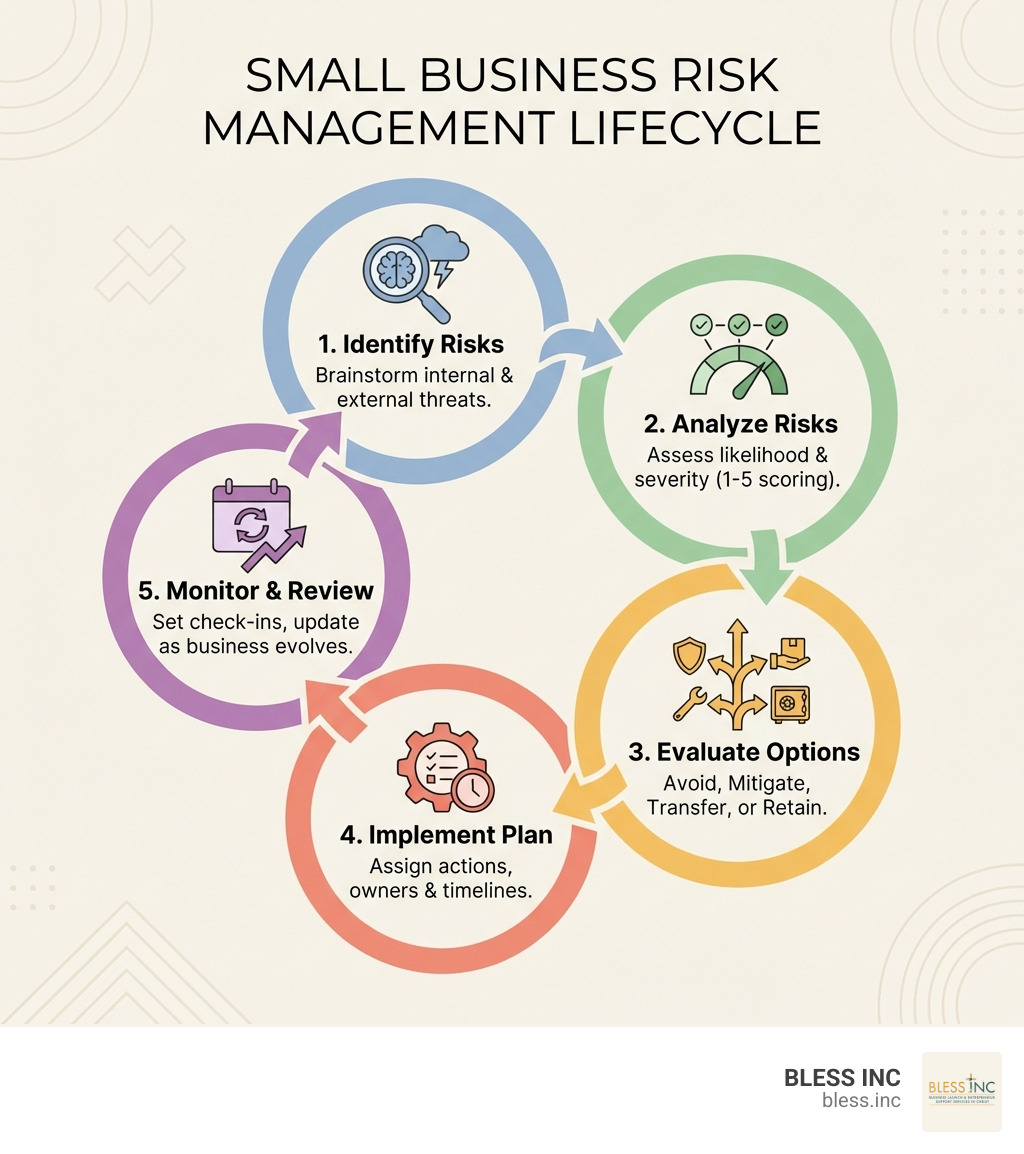
You can’t manage what you haven’t identified. We suggest gathering your team for a brainstorming session to map out potential threats.
A great resource for this is the Prepare and Protect: The Small Business Owner’s Guide to Identifying and Managing Risks | SCORE.
The Prioritization Formula
Not all risks are created equal. To prioritize them, use this simple scoring system:
Likelihood (1-5) x Severity (1-5) = Risk Score.
For example:
- Tornado: Likelihood 2, Severity 5 = Score 10.
- One Bad Review: Likelihood 4, Severity 2 = Score 8.
- Data Breach: Likelihood 3, Severity 5 = Score 15.
Address the highest scores first.
Creating Your Comprehensive Risk Management Plan
Once you’ve identified the risks, you have four ways to handle them:
- Avoidance: Stop the activity that causes the risk (e.g., stopping a high-risk service line).
- Mitigation: Reduce the impact (e.g., installing a sprinkler system or improving managed-human-resources training).
- Transfer: Pass the risk to someone else (e.g., buying insurance or outsourcing a risky task).
- Retention: Accept the risk and budget for it (e.g., self-insuring for small equipment repairs).
Our strategy-development services can help you document these choices into a formal Business Continuity Plan (BCP).
Ongoing Monitoring and Adapting to Change
Risk management isn’t a “one and done” task. The world changes—new laws are passed, new technologies emerge, and your business grows. We recommend a quarterly review cycle to update your BCP.
Leaders need support to stay on top of these shifts. Our managed-leader-support provides the accountability and expertise needed to ensure your risk plan stays relevant as you scale.
Building Resilience Through Insurance and External Resources
Insurance is the primary tool for transferring risk. While it costs money upfront, the Insurance Institute notes that every $1 spent on risk reduction saves $6 in future losses.
Key coverages to consider:
- General Liability: Protects against slip-and-fall accidents.
- Property Insurance: Covers your physical location and equipment.
- Business Interruption Insurance: Replaces lost income if you’re forced to close due to a covered disaster.
- Cyber Insurance: Helps recover costs from data breaches.
Beyond insurance, utilize the Small Business Resilience Hub | SCORE for templates and mentorship.
Leveraging Government and Community Support Programs
You don’t have to build your safety net alone. Several programs offer specialized small business risk support:
- SBA Disaster Assistance: Provides low-interest loans for physical and economic injury after a disaster.
- FDIC Insurance: Ensures your business deposits are protected up to $250,000.
- NYC SBS Workshops: The Business Preparedness and Resiliency Program offers free webinars and even grants for risk assessments in the New York area.
- Travelers SBRE: This program provides risk management workshops and microloans specifically for women-, minority-, and veteran-owned businesses.
Small Business Risk Support for Faith-Driven Entrepreneurs
At BLESS INC, we understand that for faith-driven entrepreneurs, business is more than a paycheck—it’s a calling. However, the “lonely at the top” feeling can make risk management feel like a spiritual burden rather than a strategic task.
We provide a zero-equity accelerator that offers operational support in finance, HR, and tech. Our goal is to help you embrace “prayerful risk”—the kind of risk that comes from following God’s lead—while we handle the “operational risk” that keeps you up at night.
With our tiered, sliding-scale pricing, we ensure that even early-stage founders have access to high-level risk support without giving up ownership of their vision. We focus on Christ-centered compassion, ensuring that your business practices reflect your values while remaining resilient.
Frequently Asked Questions about Small Business Risk Support
What is the most common risk faced by small businesses?
While it varies by industry, operational and financial risks are the most persistent. Specifically, cash flow mismanagement and “key person risk” (where the business depends too heavily on the owner) are the most frequent causes of small business failure.
How does insurance help in transferring business risks?
Insurance acts as a contract where you pay a premium to a company in exchange for them assuming the financial burden of a specific loss. Instead of having to pay $100,000 out of pocket for a fire, you pay a monthly fee, and the insurance company covers the catastrophic cost.
What percentage of businesses fail to reopen after a disaster?
According to FEMA, approximately 25% of businesses do not reopen following a major disaster. This is often because they lack a business continuity plan or sufficient “business interruption” insurance to cover expenses while they are closed for repairs.
Conclusion
Securing the best small business risk support doesn’t mean you have to become an expert in everything from cybersecurity to commercial law. It means knowing where to find the right tools and partners to help you build a resilient foundation.
By identifying your vulnerabilities, prioritizing them with a simple scoring system, and leveraging resources like the SBA and BLESS INC, you can move from a state of constant “firefighting” to a state of operational peace.
Risk is an inherent part of the entrepreneurial journey. It is the price we pay for the opportunity to create something new. But with the right support, you can navigate those risks with confidence and stewardship.
Secure your future with managed risk support and turn your business into a resilient vessel for your mission.