Biblical Business Full Ownership and Why It Matters for Entrepreneurs
Introduction
What Biblical Business Full Ownership Really Means (And Why It Changes Everything)
Biblical business full ownership is the understanding that, as a business owner, you are not the ultimate owner of your enterprise — God is. You are a steward, managing resources He has entrusted to you, for His purposes and His glory.
Here is a quick breakdown of what that means in practice:
- God owns it all — Psalm 24:1 says “the earth is the Lord’s, and everything in it”
- You are a steward, not a proprietor — your role is to manage wisely, not to possess absolutely
- Decisions flow from faith — strategy, hiring, pricing, and finances are all filtered through prayer and Scripture
- Success is redefined — profit matters, but so does purpose, integrity, and kingdom impact
- Full ownership (legally) is protected when you avoid giving away equity to investors, keeping you free to lead with biblical values without outside pressure
This is not just a spiritual idea. It is a practical framework that shapes how you hire, price, market, spend, and lead — every single day.
Most entrepreneurs start a business to gain control. More freedom. More income. More independence. But many faith-driven founders eventually hit a wall — burnout, moral compromise, or a nagging sense that something is off, even when the numbers look good.
That tension is real. And it often comes from a single root problem: building a business for yourself instead of as a steward for God.
The concept of biblical business full ownership flips the script entirely. Instead of asking “How do I grow my business?”, the better question becomes “How do I faithfully manage what God has placed in my hands?”
As one stewardship principle puts it simply: “God owns it all.” Those four words, when truly internalized, have the power to transform not just your business decisions — but your entire identity as an entrepreneur.
This guide will walk you through what that looks like, from daily decisions to long-term legacy.
Defining Biblical Business Full Ownership: Stewardship vs. Absolute Rights

To understand biblical business full ownership, we have to look at the tension between legal reality and spiritual truth. Legally, your name might be on the articles of incorporation. You might hold 100% of the shares. But spiritually, Psalm 24:1 reminds us that “The earth is the Lord’s, and everything in it, the world, and all who live in it.”
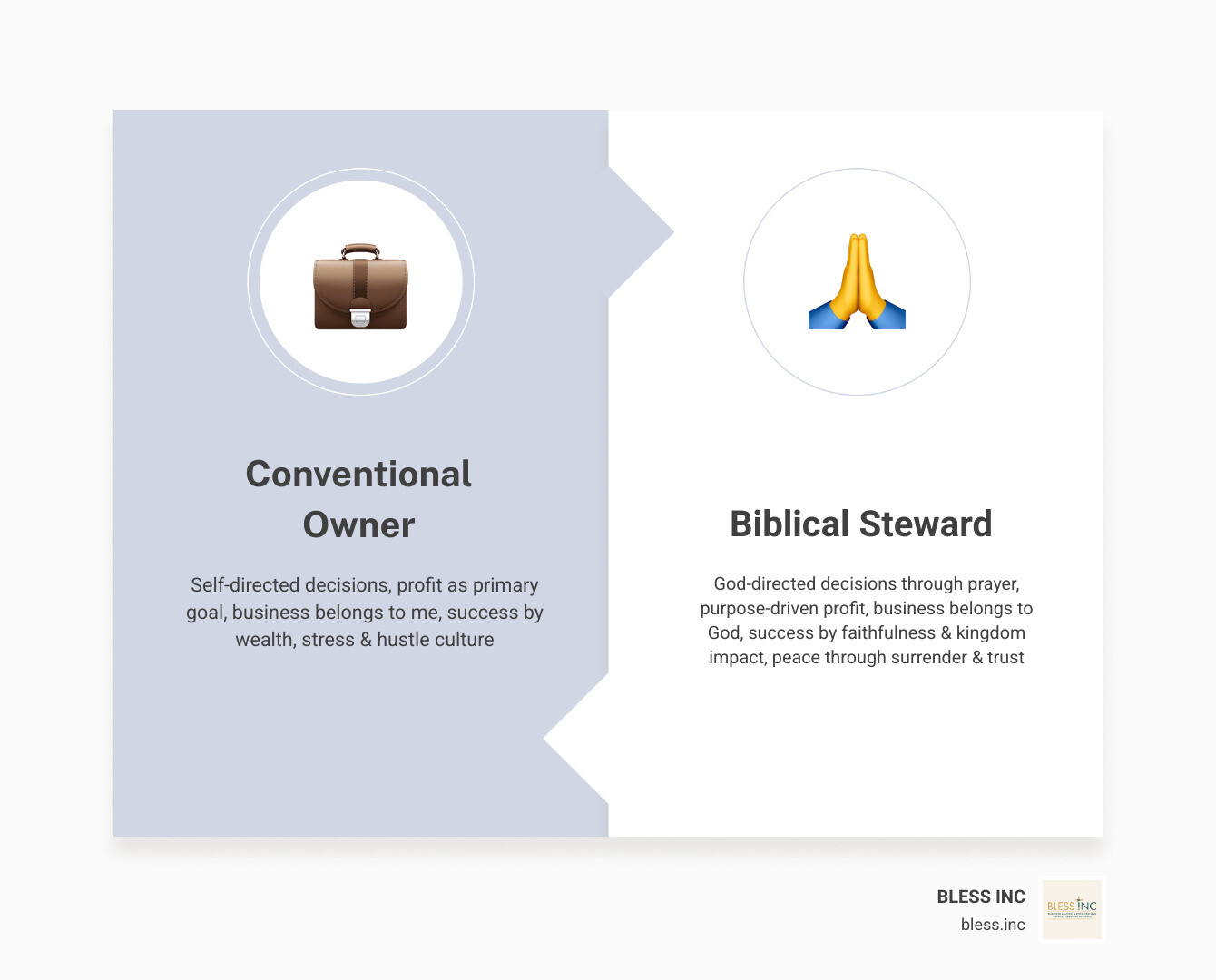
Conventional ownership says: “I built this. I take the risks. I reap the rewards. I make the rules.”
Biblical stewardship says: “God entrusted this to me. I manage the risks through His wisdom. I use the rewards for His kingdom. I follow His rules.”
When you embrace this mindset, you move from being a “proprietor” to an “overseer.” An overseer doesn’t own the property, but they are responsible for its flourishing. This shift is what allows you to run a 7-figure business without the crushing weight of “carrying” the company on your own shoulders.
By maintaining 100% legal ownership — avoiding the trap of selling equity to investors who may not share your faith — you protect your ability to live out your faith in every boardroom decision. You aren’t answerable to a secular board looking only at quarterly returns; you are answerable to the Creator who looks at the heart.
Why Biblical Business Full Ownership Requires a “God as CEO” Mindset
If God owns the business, it only makes sense that He should be the CEO. Proverbs 16:3 tells us, “Commit to the Lord whatever you do, and he will establish your plans.”
Making God your CEO isn’t just a nice sentiment for a wall plaque; it’s a strategic operational choice. It means prayerful consulting before every major launch, hire, or pivot. Think about it: if you had a human CEO with infinite wisdom and a 100% success rate, wouldn’t you check with them before signing a contract?
When we surrender the “lead” role to Him, we find a peace in your business that the world cannot replicate. You stop “throwing spaghetti at the wall” and start moving with divine intentionality. Strategic planning becomes an act of listening, and decision-making becomes an act of obedience.
Integrating Integrity into Biblical Business Full Ownership
A business built on God’s principles must be built on the bedrock of integrity. Proverbs 11:1 is very clear: “The Lord detests dishonest scales, but accurate weights find favor with him.”
In the modern marketplace, “dishonest scales” look like:
- Hidden fees in your contracts
- Exaggerated marketing claims
- Underpaying employees while the owner takes massive bonuses
- Cutting corners on product quality to save a buck
When you operate with biblical business full ownership, you realize that honesty in business is a form of worship. It means transparent pricing and fair compensation. We treat our suppliers, team members, and even competitors with the same dignity we want for ourselves. Why? Because we aren’t just trying to win a transaction; we are representing the True Owner.
Core Principles for Running a God-Centered Enterprise
The world tells us that the only way to succeed is to “hustle” — to grind 80 hours a week, sacrifice our families, and out-shout the competition. But the Bible offers a different path: diligent work paired with radical trust.
| Worldly Hustle | Biblical Diligence |
|---|---|
| Driven by fear of lack | Driven by love for God |
| Success = Net Worth | Success = Faithfulness |
| Work is an identity | Work is an act of worship |
| Sacrifices rest for profit | Prioritizes Sabbath as trust |
| “I am the source” | “God is the provider” |
Colossians 3:23 reminds us, “Whatever you do, work at it with all your heart, as working for the Lord, not for human masters.” This leads to a “second-mile mentality” (Matthew 5:41) — doing more than is expected because you aren’t just serving a client; you are serving Christ.
However, this diligence must be balanced with rest. Practicing a Sabbath is the ultimate test of whether you believe you own the business or God does. If you can’t stop working for 24 hours, you might be addicted to the “hustle” or afraid that the business will fail without you. True stewardship involves overcoming overwhelm by surrendering your to-do list to the one who created time itself.
Finally, we must surround ourselves with wise counsel. Proverbs 13:20 says, “Walk with the wise and become wise, for a companion of fools suffers harm.” Whether it’s a mentor, a godly board of advisors, or a community of faith-driven peers, you need people who will hold you to biblical standards when the pressure to compromise rises.
Financial Stewardship and the Pursuit of Godly Profit
Is it “wrong” for a Christian business to make a profit? Absolutely not. In fact, profit is a measure of the value you’ve created for others. However, in biblical business full ownership, profit is a tool, not a god.
One practical way many kingdom entrepreneurs manage their resources is the 10/10/80 rule:
- 10% Tithe: Giving back to the local church or kingdom work first.
- 10% Savings/Investment: Preparing for the future and building a “storehouse” for lean times.
- 80% Operations and Living: Managing the rest with wisdom and excellence.
Proverbs 13:11 tells us that “wealth from get-rich-quick schemes quickly disappears; wealth grows over time through hard work.” We don’t chase shortcuts; we build for the “fourth generation.”
As a business owner, you should also consider your public benefits. Does your business model bless the community? Does it provide fair wages that allow your employees’ families to thrive? Mark 8:36 poses the ultimate question for every CEO: “What good is it for someone to gain the whole world, yet forfeit their soul?”
Kingdom ROI (Return on Investment) isn’t just measured in dollars; it’s measured in lives changed, families supported, and the Gospel advanced. When you retain 100% ownership, you have the unencumbered power to be radically generous with your profits, supporting missions and local needs without needing permission from secular shareholders.
Frequently Asked Questions about Biblical Business Ownership
Is it unbiblical to have business partners or investors?
The Bible doesn’t forbid partnerships, but it gives strong warnings about being “equally yoked” (2 Corinthians 6:14). If you take on a partner or an investor who does not share your biblical values, you will eventually face a “values collision.”
When an investor puts money into your company in exchange for equity, they often gain a say in how the business is run. If their primary goal is maximizing profit at any cost, and your goal is kingdom impact, you will find yourself in a difficult position. This is why we advocate for retaining biblical business full ownership whenever possible. Stewardship is much easier when you don’t have to compromise with “the world’s way” to please a financial backer.
How do I balance ambition with humility?
Ambition is not a sin; in fact, God gave us the “cultural mandate” in Genesis to subdue the earth and develop its resources. However, there is a difference between selfish ambition and godly ambition.
Philippians 2:3 tells us, “Do nothing out of selfish ambition or vain conceit. Rather, in humility value others above yourselves.” Godly ambition seeks to grow the business so that more people can be served and more resources can be funneled into the Kingdom. Humility recognizes that any success you achieve is a gift from God. You can be the most “successful” person in your industry and still walk in total humility if you remember that you are simply a steward of His grace.
What does it mean to “work for the Lord” in a secular market?
You don’t have to sell Bibles or Christian T-shirts to have a “ministry.” Whether you run a landscaping company, a tech startup, or a retail shop, your business is your platform.
Working for the Lord (Colossians 3:24) means:
- Quality Work: Your products should be the best in the market because they represent the King.
- Salt and Light: Your interactions with difficult clients or competitors should reflect Christ’s character.
- Marketplace Ministry: You have access to people (employees, vendors, customers) that a pastor might never meet. Your business is the “front line” of the Gospel.
Conclusion: Building a Legacy That Outlasts the Marketplace
At the end of the day, biblical business full ownership is about legacy. Not the kind of legacy that puts your name on a building, but the kind that hears “Well done, good and faithful servant” from the True Owner.
Running a business is hard. Scaling a business while keeping your faith at the center is even harder. You don’t have to do it alone. At BLESS INC, we understand the unique challenges of the faith-driven entrepreneur. We provide the operational support you need — from finance and HR to tech and admin — through our zero-equity accelerator.
Our mission is to help you thrive without asking for a piece of your company. We believe in your calling, and we want to see you retain 100% ownership so you can lead exactly as God directs you. With our tiered, sliding-scale pricing, we make professional-grade support accessible to founders at every stage.
Are you ready to stop “owning” and start stewarding? Are you ready to see what happens when you truly make God the CEO?
Discover our services and let’s build something with eternal impact together.