Zero Equity Accelerator Program Guide for Founders Who Hate Dilution
Why Every Founder Should Know About Zero Equity Accelerator Programs
A zero equity accelerator program is a startup program that gives you mentorship, funding, and resources — without taking a single share of your company.
There are several well-known options available today that focus on different industries, from healthcare and biotech to SaaS and climate tech. These programs provide varying levels of funding, often ranging from $30,000 to over $500,000 in non-dilutive awards, while others focus on providing free resources and technical support for several months.
You keep 100% of your company. No dilution. No strings.
These programs exist because governments, corporations, and technical partners want to support innovation — without needing an ownership stake to benefit from it.
If you’re a founder already stretched thin across finance, HR, operations, and your actual product, giving away equity on top of all that can feel like losing a piece of what you worked so hard to build. Traditional accelerators often take 5–10% equity in exchange for their support. That adds up fast, especially when you’re just getting started.
The good news? Zero equity accelerator programs are growing globally — and they’re becoming more competitive, more funded, and more sector-specific than ever.
Top-tier zero equity programs have already helped hundreds of alumni raise hundreds of millions in funding, generate significant revenue, and create thousands of jobs — all without taking equity from a single participant.
This guide breaks down exactly how these programs work, what to look for, and how to find the right fit for where you are right now.
What Defines a Zero Equity Accelerator Program?
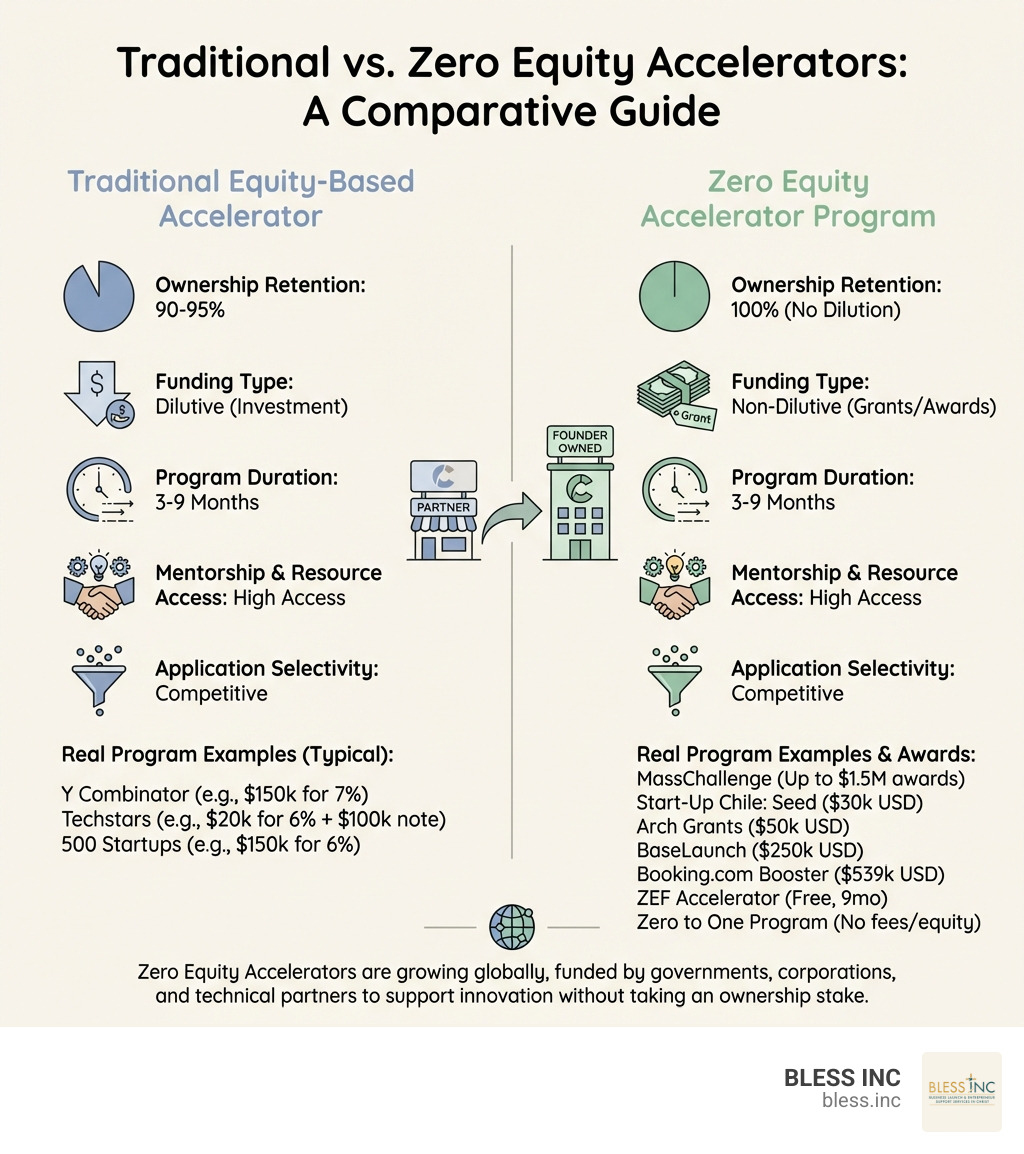
At its core, a zero equity accelerator program is an intensive business support initiative designed to speed up the growth of early-stage companies without requiring an ownership stake in return. While a traditional accelerator usually operates on an “equity-for-capital” model—taking a slice of your company in exchange for a small cash injection—zero equity models prioritize founder autonomy.
These programs are often funded by government grants, corporate social responsibility (CSR) budgets, or technical partners looking to build long-term relationships. For example, some technical partners offer specialized programs where they provide full development support for a single selected founder per cycle, covering all development costs without taking equity.
Ownership Retention and Non-Dilutive Grants
The most significant differentiator is how you handle your cap table. In a zero equity environment, you retain 100% ownership. Instead of selling shares, you might receive “non-dilutive” funding. This can come in the form of:
- Cash Awards: High-stakes competitions where top performers win prizes (sometimes exceeding $1 million in specific regional hubs).
- Stipends: Monthly payments to cover living costs so you can focus entirely on your build.
- Prototype Grants: Specific funds (sometimes around $2,000) dedicated to moving from a concept to a physical or digital product.
Mentorship and Technical Partnership
Beyond the money, these programs provide high-level mentorship and technical resources. You aren’t just getting a check; you’re getting a seat at the table with industry experts. Many programs offer 1-to-1 coaching and access to global networks of investors and corporate partners. This accelerator original approach ensures that even without an equity stake, the program is deeply invested in your success because your growth serves as a case study for their effectiveness.
| Feature | Traditional Accelerator | Zero Equity Accelerator |
|---|---|---|
| Equity Taken | Typically 5% – 10% | 0% |
| Funding Source | Venture Capital / Private Equity | Government / Corporate / Grants |
| Primary Goal | Return on Investment (ROI) | Ecosystem Growth / Innovation |
| Ownership | Diluted | 100% Retained |
| Cost to Founder | High (Long-term value of equity) | Low to None |

Key Benefits of a Zero Equity Accelerator Program
Why do founders choose these programs? It isn’t just about the “free” money. The benefits extend into the very DNA of your startup’s future.
- Full Ownership and Control: You make the decisions. You don’t have a new “boss” on your board of directors who is only looking at the next exit. This is vital for mission-driven or faith-driven entrepreneurs who want to ensure their values remain the core of the company.
- Market Validation: Being selected for a highly competitive program is a massive signal to the market. Various university-based entrepreneurship centers offer intensive programs that help aspiring entrepreneurs turn ideas into sustainable ventures.
- Mentorship Value: Statistics show that 92% of participants in specialized accelerators found mentorship crucial for refining their business strategies. This guidance helps you accelerate growth by avoiding common pitfalls that sink early-stage startups.
- Investor Readiness: Even though the program doesn’t take equity, they prepare you for those who will. Approximately 78% of startups that complete top-tier zero equity programs secure follow-on funding within a year. They help you polish your pitch, clean up your financials, and get in front of the right VCs.
- Networking: Joining an accelerator plugs you into a “ready-made” network. About 88% of startups reported a stronger network of industry connections post-program. This includes access to Trade Commissioners for international expansion or corporate sponsors looking for new technology to acquire.
Intellectual Property and Financial Structures
One of the biggest concerns for any founder is: “If I’m not paying with equity, what am I paying with?” Generally, the “cost” is your time and commitment, but you must understand the legal and financial structures involved.
IP Ownership and Licensing
In almost every reputable zero equity accelerator program, you retain 100% of your Intellectual Property (IP). However, you will often sign a “Terms of Participation” agreement. This usually includes a limited, royalty-free license for the accelerator to use your company name, logo, and certain non-confidential media (like photos of you in the program) for their own marketing and “showcase” purposes.
It is also standard for these programs to include a “non-confidentiality” clause regarding general ideas. This means that while your specific code or trade secrets are yours, the general industry knowledge shared in group sessions isn’t protected. This allows for a freer exchange of ideas between peers.
Financial Support Without the Catch
The financial structures of these programs are designed to remove barriers to entry. Many offer accelerate pricing models or are entirely free. Common financial perks include:
- Living Expense Scholarships: Some university-based programs provide over $6,000 for living costs to support up to three team members during the program.
- Prototyping Funds: Grants of around $2,000 are common for hardware or tech-heavy startups to build their first MVP.
- Partner Benefits: Many accelerators provide “perks” like $100,000 in cloud credits (AWS/Azure) or free access to CRM software, which can save a startup thousands in its first year.
Common Non-Dilutive Funding Amounts
Non-dilutive funding varies by program and stage. Early-stage seed grants often start around $30,000 USD, while location-based growth grants can offer $50,000 USD. High-impact global competitions have been known to award prizes exceeding $500,000 USD to help startups scale without equity dilution.
Program Selection and Eligibility
Not every zero equity accelerator program is a fit for every startup. Because these programs don’t take equity, they are often more selective than traditional ones. They want to ensure their resources are going to founders who have a high probability of making a real-world impact.
Sector-Specific Focus
Many programs are narrowing their scope to solve specific global problems:
- Climate Tech: Specialized 9-month programs exist specifically for decarbonization and sustainability startups.
- SaaS and AI: Technical partners often look for “visionary” tech leaders. If you have a bold idea but lack the dev team, you might Apply Now for Technical Partnership to build and launch your product with a world-class team.
- International Growth: Some programs focus entirely on market-entry strategies and connecting you with Trade Commissioners.
The “Up-or-Out” Model
Some modern programs use an “up-or-out” progression system. This means that while the program might be free to join, your ability to stay in the program and reach graduation depends on your demonstrated progress and participation. It keeps founders accountable. If you aren’t hitting your milestones, you lose your spot to someone who will.
Eligibility and Deadlines
Most programs require you to have at least a “Minimum Viable Product” (MVP) or a very strong business case. For instance, a zero-equity-accelerator might look for founders who are ready to scale their operations rather than those who just have a “napkin sketch” idea.
- Geography: Some grants require you to relocate to a specific city for a year to foster local economic growth.
- Stage: Some are “pre-accelerators” for students, while others are for “scale-ups” generating revenue.
- Deadlines: These are usually firm. Many top-tier programs typically open applications in the first quarter of the year and close them by spring.
Finding the Right Zero Equity Accelerator Program
Choosing the right program is like choosing a co-founder—you need to align on values and goals.
- Strategic Fit: Does the program offer the specific resources you need? If you are a hardware startup, look for programs with specialized prototyping labs. If you need to accelerate scale, look for programs with deep corporate connections.
- Technical Resources: If you are a non-technical founder, a program that provides a technical partner is worth more than a cash grant. Having a team to help you launch can lead to a 70% product launch rate within three months of completion.
- Alumni Success: Look at the track record. Have past graduates raised money? Have they stayed in business? A program with a strong alumni network provides a “warm” path to future investors.
- Tiered Support: Some programs offer different levels of engagement. You might start with a virtual curriculum and move into intensive 1-on-1 mentoring. Checking an accelerator tier comparison can help you see which level of support matches your current bandwidth.
Frequently Asked Questions about Zero Equity Accelerators
Do zero equity accelerators really charge no fees?
Most true zero equity accelerator programs are free. They are funded by sponsors, governments, or partners who benefit from the innovation you bring or the economic growth you create. However, some “boutique” or specialized accelerators may use a “pay-to-play” model or a tiered, sliding-scale fee structure to cover operational costs without taking your shares. Always read the fine print to ensure there are no “hidden” equity warrants or success fees.
How do these programs handle my intellectual property?
You almost always keep 100% of your IP. The program may ask for a limited license to show off your progress in their marketing materials, but the “secret sauce” stays with you. Be aware that in group “pitch” sessions, confidentiality is hard to maintain, so don’t share your most sensitive trade secrets in a room full of other founders.
What are the typical success metrics for graduates?
Success is measured by growth, not just exits. Common metrics include:
- Funding: 78% of graduates secure funding within 12 months.
- Product Launch: 70% launch a new product or service within 3 months of finishing.
- Revenue: Many alumni report significant revenue growth (some hitting $1M+ annual revenue shortly after graduation).
- Jobs: Leading programs track job creation, with alumni creating thousands of new roles in their local ecosystems.
Conclusion
Finding a zero equity accelerator program is one of the smartest moves a founder can make to protect their future. By retaining 100% ownership, you keep the freedom to build your company exactly how you envisioned it—whether that’s scaling to a global IPO or building a sustainable, mission-driven business.
At BLESS INC, we understand that as a founder, you have enough on your plate. You shouldn’t have to choose between getting the support you need and giving away the equity you’ve earned. We provide comprehensive operational support—including finance, HR, tech, and admin—specifically for faith-driven entrepreneurs. Our model is built on Christ-centered compassion and a commitment to helping you succeed while you retain full ownership of your vision.
We offer a zero-equity accelerator environment with tiered, sliding-scale pricing designed to meet you where you are. We handle the “back-office” heavy lifting so you can focus on your calling and your customers.
Start your journey with a Zero Equity Accelerator Program today and see how much faster you can grow when you aren’t held back by dilution or administrative overwhelm. Let us help you build something that lasts, without taking a piece of what’s yours.
How Managed Bookkeeping Services Save You from Financial Facepalms
What are Managed Bookkeeping Services?
Managed bookkeeping services are professional, outsourced solutions that handle your business’s financial record-keeping — including transaction recording, bank reconciliation, and financial statement preparation — so you don’t have to.
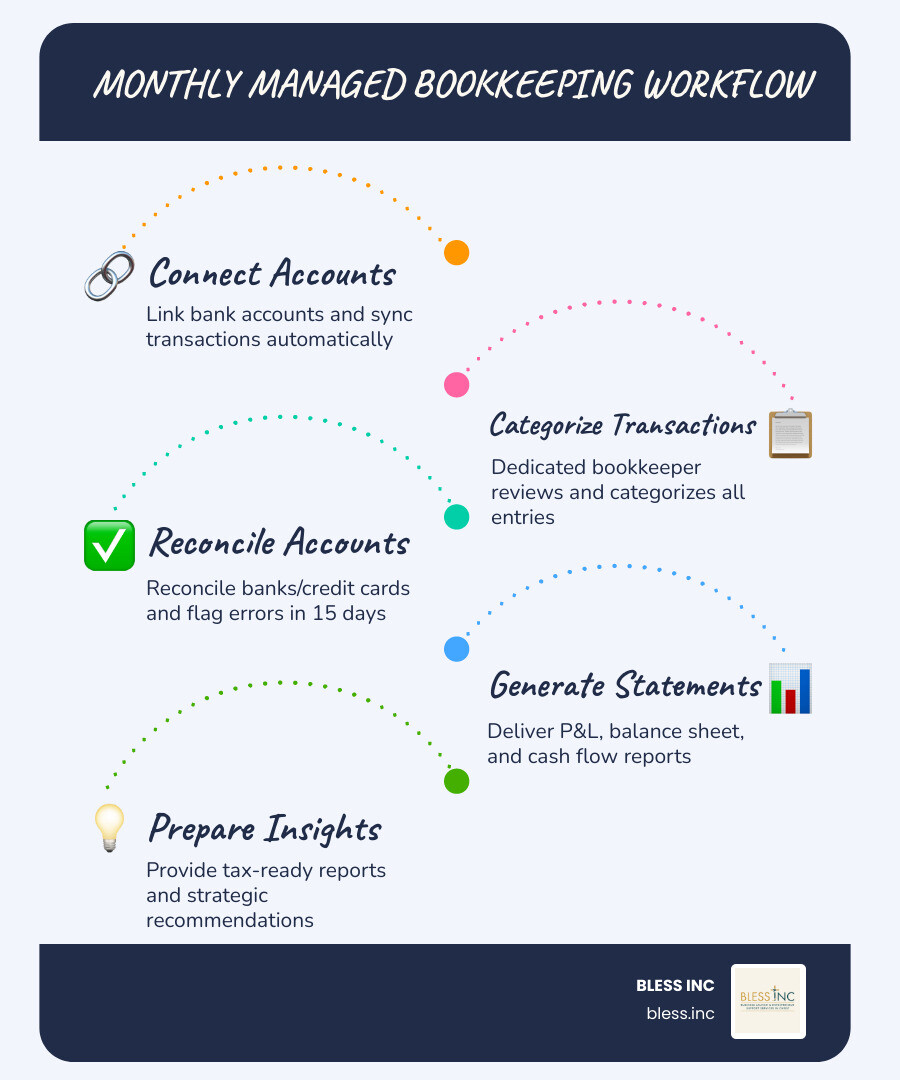
Here’s what managed bookkeeping services typically include:
- Recording and categorizing daily transactions
- Monthly bank and credit card reconciliations
- Profit & loss statements, balance sheets, and cash flow reports
- Tax-ready books delivered on a regular schedule
- Cloud-based access to your financials in real time
- Dedicated bookkeeper support (chat, call, or email)
If you’re a business owner wearing five hats at once, you already know the feeling. Receipts piling up. Spreadsheets that don’t balance. Tax season sneaking up like an unwanted guest.
You’re not alone. Almost 62% of small businesses plan to outsource more of their bookkeeping in the coming year — and it’s easy to see why.
Managing your own books takes time you don’t have. And when the numbers are wrong, the consequences show up later in the worst possible ways: missed deductions, IRS notices, and financial blind spots that slow your growth.
Managed bookkeeping services exist to fix exactly that — giving you clean, accurate books every month without the overhead of a full-time hire.
At its core, Managed Bookkeeping is the engine room of your business’s financial health. While traditional bookkeeping often involves a local professional visiting your office once a quarter to sort through paper folders, managed services leverage modern technology to provide a continuous, high-touch experience.
We focus on the daily heavy lifting: transaction recording and general ledger maintenance. Every time you swipe a business card or receive a payment via Stripe or PayPal, that data needs a home. Our team ensures every cent is categorized correctly according to standard accounting principles.
The Power of Cloud-Based Automation
Modern managed bookkeeping services utilize cloud-based platforms to create a “living” financial record. Instead of waiting weeks for a report, automation allows for real-time visibility. We sync your bank feeds directly into the software, reducing manual entry errors and ensuring that your books are always moving toward a “closed” state.
Accrual vs. Cash Basis: Why It Matters
Understanding your profitability depends heavily on your accounting method.
- Cash Basis: Records income when it hits your bank and expenses when they leave. It’s simple but can hide the true timing of your business obligations.
- Accrual Basis: Records income when earned and expenses when incurred. This provides a much clearer picture of your long-term financial health, especially for businesses with inventory or long-term contracts.
By providing professional financial statement preparation, we help you move beyond simple “checkbook accounting” into sophisticated reporting that banks and investors actually trust.
The Top Benefits of Outsourcing to Managed Bookkeeping Services
Why are over 65% of companies choosing to outsource their bookkeeping today? The answer usually comes down to the “Three A’s”: Accuracy, Administrative Relief, and Affordability.
Cost Efficiency and 40-60% Savings
Hiring a full-time, in-house accountant is expensive. When you factor in salary, health benefits, payroll taxes, office space, and software licenses, the costs skyrocket. Research indicates that outsourcing can lead to up to 60% savings compared to in-house management. According to Global Growth Insights on outsourcing trends, businesses are increasingly turning to managed models to search for smarter, more efficient ways to keep their books without the overhead of a traditional employee.
To see how these savings apply to your specific situation, you can use our Cost Estimator to compare the investment of managed services against the high price of doing it yourself or hiring internally.
Accuracy and Tax Readiness
“Bad bookkeeping costs more at tax time than good bookkeeping costs monthly.” We’ve seen it happen: a DIY business owner spends six hours trying to fix a Stripe deposit mismatch, only to realize they’ve accidentally commingled personal expenses. Professional managed bookkeeping services ensure your books are tax-ready from day one. This reduces the “cleanup” fees your CPA would otherwise charge you in April and ensures you never miss a valid deduction.
Scalability for Growing Businesses using Managed Bookkeeping Services
Growth is exciting, but it’s also the time when financial systems typically break. Whether you are preparing for Seed rounds or Series A preparation, investors will demand “clean” books. They want to see your burn rate, your customer acquisition costs, and your historical revenue trends without any “noise” in the data.
Our Client Resources provide the framework for this transition. Managed services allow you to scale your accounting function much faster than internal hiring. If your transaction volume doubles overnight, we simply scale our support to match, providing investor-ready financials that give you the confidence to close your next funding round.
Specialized Support for S-Corps and Nonprofits
Different business structures have vastly different rules. We don’t believe in a one-size-fits-all approach.
- S-Corps: Proper bookkeeping is vital for managing shareholder distributions vs. reasonable salaries. According to the Federal Register S-Corp tax savings data, sole proprietors with over $40,000 in profit can see significant self-employment tax savings by electing S-Corp status—but only if their books are accurate enough to support the filing.
- Nonprofits: 501(c)(3) organizations must adhere to strict nonprofit accounting standards regarding fund accounting and donor restrictions. We help ensure your organization remains compliant with state and federal rules so you can focus on your mission.
Comparing Managed Solutions to DIY and In-House Accounting
Many entrepreneurs start with DIY bookkeeping because it feels “free.” However, the hidden costs of DIY—including the value of your own time and the risk of expensive errors—often make it the most expensive option in the long run.
| Feature | DIY Bookkeeping | Managed Services | In-House Accountant |
|---|---|---|---|
| Monthly Cost | Low ($) | Moderate ($$) | High ($$$) |
| Time Commitment | High (Owner’s time) | Minimal | Minimal |
| Accuracy | High Risk of Error | Professional Guarantee | High |
| Scalability | Difficult | Seamless | Requires new hire |
| Strategic Insight | None | High (CFO level) | Varies |
As noted in recent LinkedIn business trends for 2025, smart owners are moving away from the “scutwork” of administrative tasks to focus on growth activities. Software alone has limitations; it can’t tell you why your cash flow is down when sales are up. That requires professional oversight.
The BLESS INC Advantage: Personalized & Expert Support
We offer more than just data entry. Our team includes Quickbooks ProAdvisor certified support, ensuring that we are utilizing the world’s leading accounting platform to its full potential.
But expertise is only half the battle. We provide personalized business advice rooted in Christ-centered compassion. We don’t just send you a PDF at the end of the month; we help you understand what the numbers mean for your family, your employees, and your future. With deep software integration and comprehensive tax readiness, we act as an extension of your team.
Strategic Value: CFO Insights and KPI Tracking
The real magic of managed bookkeeping services happens when we move from “what happened” to “what’s next.” Recording transactions is the baseline; strategic advisory is the ceiling.
By tracking Key Performance Indicators (KPIs), we help you answer the tough questions:
- Cash Flow Modeling: If you hire two more people next month, when will you run out of cash?
- Profitability Analysis: Which of your products or services is actually making money after all expenses are considered?
- Expense Ratios: Are your marketing costs growing faster than your revenue?
- Burn Rate Monitoring: For startups, knowing exactly how many months of “runway” you have left is the difference between scaling and stalling.
Data-driven decision-making replaces “gut feelings,” allowing you to make bold moves with the safety net of accurate financial data.
Frequently Asked Questions
Can managed services handle catch-up bookkeeping?
Absolutely. If you haven’t looked at your books in six months (or six years), don’t panic. Historical cleanup is one of our specialties. We perform overdue reconciliations to bring your accounts current, often within 15-day delivery cycles for monthly reports once the backlog is cleared. This ensures you are fully prepared for tax season, no matter how far behind you started.
What security measures protect my financial data?
We take data protection with the utmost seriousness. Our systems utilize bank-grade encryption and follow stringent Privacy policy standards. We adhere to AICPA guidelines, utilizing multi-factor authentication (MFA) and secure document portals to ensure that your sensitive financial information never falls into the wrong hands.
How does the onboarding process work?
Getting started is simpler than most owners expect. The process typically involves:
- Bank Feed Connection: We help you securely link your accounts for automated transaction syncing.
- Software Migration: If you’re moving from spreadsheets or another platform, we handle the data transfer.
- Dedicated Bookkeeper Matching: You are paired with an expert who understands your specific industry and entity type.
Ready to get started? You can Get in Touch with our team today for a discovery call.
Conclusion
At BLESS INC, we understand that for faith-driven entrepreneurs, a business is more than just a source of income—it’s a calling. That’s why we provide a zero-equity accelerator model that offers the operational support you need while allowing you to retain 100% ownership of your vision.
By utilizing our Managed Bookkeeping Services, you aren’t just “outsourcing tasks”; you are reclaiming your time to focus on the mission God has placed on your heart. Let us handle the spreadsheets so you can lead your company with clarity, confidence, and a total lack of financial facepalms.
Don’t Let PTO Ruin Your Life: Finding a Better Leave Management System
When PTO Tracking Becomes a Full-Time Job (And How to Fix It)
If you’re searching for the right hr leave management system, there are several categories of software to consider in 2025, ranging from mobile-first platforms for deskless teams to comprehensive suites for growing businesses. Most systems offer flexible pricing, often starting as low as $1 to $10 per user per month, with free tiers available for very small startups.
Picture this: an employee asks if they can take next Friday off. Before you can answer, you have to check their leave balance, confirm nobody else on their team is already out, and update three separate spreadsheets. And you’re doing this alone, while also handling payroll, compliance, and a dozen other things.
Sound familiar? You’re not alone.
Many small business owners and solo HR managers still rely on manual processes or outdated tools. That leads to calculation errors, scheduling conflicts, compliance risks, and hours of wasted time every single week.
The good news? A modern hr leave management system automates all of that. Employees submit requests through an app or chat tool. Managers approve with one click. Balances update automatically. No paperwork. No inbox overload.
This article breaks down the best systems available right now, what to look for, and how to pick the right one for your team size and budget — so you can stop managing spreadsheets and start leading your business.
System checks leave balance and team calendar automatically > Manager receives instant notification and approves or declines with one click > Leave balance updates in real time > Payroll system syncs automatically > Employee receives confirmation notification > HR dashboard reflects updated team availability – hr leave management system infographic ” class=”aligncenter” src=”https://images.bannerbear.com/direct/4mGpW3zwpg0ZK0AxQw/requests/000/133/392/531/g4ZpR2ONeYJLORGr6Eqvo9WBA/14957fabb0b2903e67287468294a14cf98238ff3.jpg” style=”display: block; margin-left: auto; margin-right: auto; max-width: 100%;” title=”Infographic showing the automated leave request lifecycle: Employee submits PTO request via app or chat > System checks leave balance and team calendar automatically > Manager receives instant notification and approves or declines with one click > Leave balance updates in real time > Payroll system syncs automatically > Employee receives confirmation notification > HR dashboard reflects updated team availability – hr leave management system infographic “/>
Understanding the Modern HR Leave Management System
At its core, an hr leave management system is a digital solution designed to handle the end-to-end process of employee time-off requests. Gone are the days of paper forms gathering dust on a desk or “lost” emails. These modern platforms act as a single source of truth for your company’s attendance data.
When we talk about these systems, we’re looking at cloud-based tools that offer real-time visibility. This means that the moment a request is approved, the team calendar updates, the employee’s balance is deducted, and the payroll report reflects the change. It creates a transparent environment where everyone—from the CEO to the newest intern—knows exactly where they stand regarding their benefits.
One of the most critical aspects of these systems is their ability to track FMLA usage and compliance. Managing Family and Medical Leave Act requirements manually is a legal minefield. A robust system tracks these hours automatically, ensuring you stay within federal guidelines without having to manually count days on a desk calendar.
Key Features to Look for in an HR Leave Management System
Not all software is created equal. When we evaluate these tools, we look for specific “must-have” functionalities that separate a mediocre tool from a life-saving one.
| Feature | Manual Spreadsheet | Automated System |
|---|---|---|
| Accuracy | High risk of human error | 100% policy enforcement |
| Visibility | Hidden in files | Real-time shared calendars |
| Accessibility | Office-bound | Mobile & Chat-based |
| Compliance | Manual tracking | Automated alerts & audits |
| Employee Experience | Frustrating/Slow | Instant self-service |
The best systems include:
- Mobile Accessibility: Essential for deskless or remote teams. Modern mobile-first tools allow employees to snap photos of medical certificates or request leave while on the go.
- Policy Customization: Your business is unique. You need a system that handles custom accrual logic—whether you offer “unlimited” PTO, earned hours per pay period, or tenure-based increases.
- Carry-over Rules: Automatically managing how many days can roll over into the new year prevents the “January 1st spreadsheet panic.”
- Self-Service Portals: This empowers employees to check their own balances, reducing the number of “How many days do I have left?” emails hitting your inbox.
For teams that need more than just a tracker, exploring managed HR services can provide the professional oversight needed to ensure these features are configured correctly from day one.
How an HR Leave Management System Ensures Legal Compliance
Compliance isn’t just a buzzword; it’s about protecting the business you’ve worked so hard to build. In the US, labor laws can vary significantly. A digital system helps you maintain excellence in workplace practices by ensuring every employee is treated fairly according to both law and company policy.
These systems provide:
- Audit Trails: Every request, approval, and denial is logged with a timestamp and the user’s ID. If a dispute ever arises, you have an immutable record of what happened.
- Statutory Entitlements: Advanced global tools come pre-loaded with regional labor law templates. This is vital for businesses with employees in different states or countries.
- Data Residency: For security-conscious firms, knowing exactly where your data is stored is a key compliance requirement.
- Automated Alerts: The system can notify you if an employee is approaching a legal limit for sick leave or if a manager hasn’t responded to a request within the required timeframe.
Why Your Business Must Move Beyond Spreadsheets
We’ve all been there—the “Master Spreadsheet” that only one person knows how to use. Then, a formula breaks. Or someone accidentally deletes a row. Suddenly, your PTO data is a mess.

The risks of staying on spreadsheets are higher than many realize:
- Version Control Issues: Is “PTOFinalv2.xlsx” actually the final version? Usually not.
- Calculation Errors: Manual entry leads to mistakes. Even a 1% error rate across 50 employees can lead to thousands of dollars in payroll discrepancies.
- Visibility Gaps: Managers often approve leave without seeing the “big picture.” This leads to staffing shortages where an entire department is out at once because nobody checked the master file.
- Employee Frustration: Employees want to plan their lives. Waiting three days for a manager to check a spreadsheet is a morale killer.
By moving to a dedicated system, you eliminate these bottlenecks. If you’re feeling overwhelmed by the transition, managed HR services can take the weight off your shoulders, handling the migration so you don’t have to.
Selecting the Best Software Category for Your Team
Choosing the right hr leave management system depends on how your team works. Are you always in Slack? Do you need a full HR suite?
All-in-One HR Suites for Comprehensive Management
If you want one login for everything—onboarding, performance reviews, payroll, and leave—a comprehensive all-in-one suite is the way to go.
- Pros: Unified data. When you hire someone, they are automatically added to the PTO system.
- Cons: These can be more expensive and sometimes include features you don’t actually need yet.
Standalone PTO Trackers for Specialized Efficiency
Sometimes, you just need a tool that does one thing exceptionally well. Standalone trackers focus purely on time off.
- Pros: Rapid implementation (some take less than 30 minutes to set up), simple interfaces, and often much lower costs.
- Cons: You may need to manually sync data with your payroll system if an integration isn’t available.
Implementation and Onboarding Best Practices
Switching to a new system doesn’t have to be a headache. We recommend a structured approach to ensure high user adoption:
- Data Migration: Export your current data to a CSV file. Clean up any inconsistencies before importing it into the new system.
- Policy Configuration: Set up your rules (accruals, carry-overs, blackout dates) and test them with a “dummy” employee account first.
- Employee Rollout: Don’t just send a login link. Record a quick 2-minute Loom video showing them how to request a day off.
- Feedback Loops: Ask your managers after the first month if the approval process is working for them.
Frequently Asked Questions about Leave Management
How much does leave management software typically cost?
Pricing varies based on the depth of features.
- Basic/Standalone: $1 – $5 per user/month.
- Standard Suites: $6 – $10 per user/month.
- Enterprise: Custom quotes, often involving a base fee plus a per-user charge.
Many tools offer free tiers for very small teams (usually under 5 or 10 users).
Can these systems handle global teams and multi-region compliance?
Yes! Specialized global systems are built specifically for this. They include location-based automation that automatically applies the correct public holidays and statutory leave rules based on where the employee is located.
What integrations are essential for a leave management tool?
At a minimum, you should look for:
- Calendar Sync: (Google Calendar/Outlook) so absences show up where people actually work.
- Collaboration Tools: (Slack/Microsoft Teams) to allow for “one-click” approvals within your chat app.
- Payroll: To ensure that paid leave is accurately reflected in paychecks without manual data entry.
Conclusion
Operational excellence isn’t just about having the best product; it’s about how you treat your people and manage your time. At BLESS INC, we believe in supporting faith-driven entrepreneurs by removing the administrative burdens that stifle growth. Our zero-equity acceleration model is built on Christ-centered compassion, ensuring you retain 100% ownership while gaining the professional support you need.
Don’t let a messy spreadsheet be the reason your team feels burnt out or your payroll is incorrect. Whether you choose a standalone tracker or decide to partner with us for managed HR services, the goal is the same: freedom to focus on your calling.
Ready to reclaim your time? Let’s find the system that works for you.
Keep Calm and Follow NIST Incident Management
Why NIST Incident Management Is Your First Line of Defense
NIST incident management is a structured, four-phase process for handling cybersecurity threats — from the moment you prepare, all the way through lessons learned after an attack.
Here’s the quick version:
- Preparation – Build your plan, team, and tools before anything goes wrong
- Detection and Analysis – Spot the threat and understand its scope
- Containment, Eradication, and Recovery – Stop the damage, remove the threat, restore operations
- Post-Incident Activity – Review what happened and improve for next time
This process is defined in NIST Special Publication 800-61, now in its third revision (April 2025), and it maps directly to the NIST Cybersecurity Framework (CSF) 2.0.
Cyberattacks don’t take days off. And as a faith-driven entrepreneur wearing every hat in your organization, a security incident can feel like the worst possible interruption — one you’re completely unprepared for.
Here’s the hard truth: most organizations that suffer serious damage from a breach weren’t caught off guard by a sophisticated attacker. They were caught without a plan.
NIST has spent decades building a framework that any organization — large or small — can follow to respond to incidents calmly, consistently, and effectively. The good news? You don’t need a massive IT department to follow it. You need clarity, structure, and the right process.
This guide walks you through exactly that.
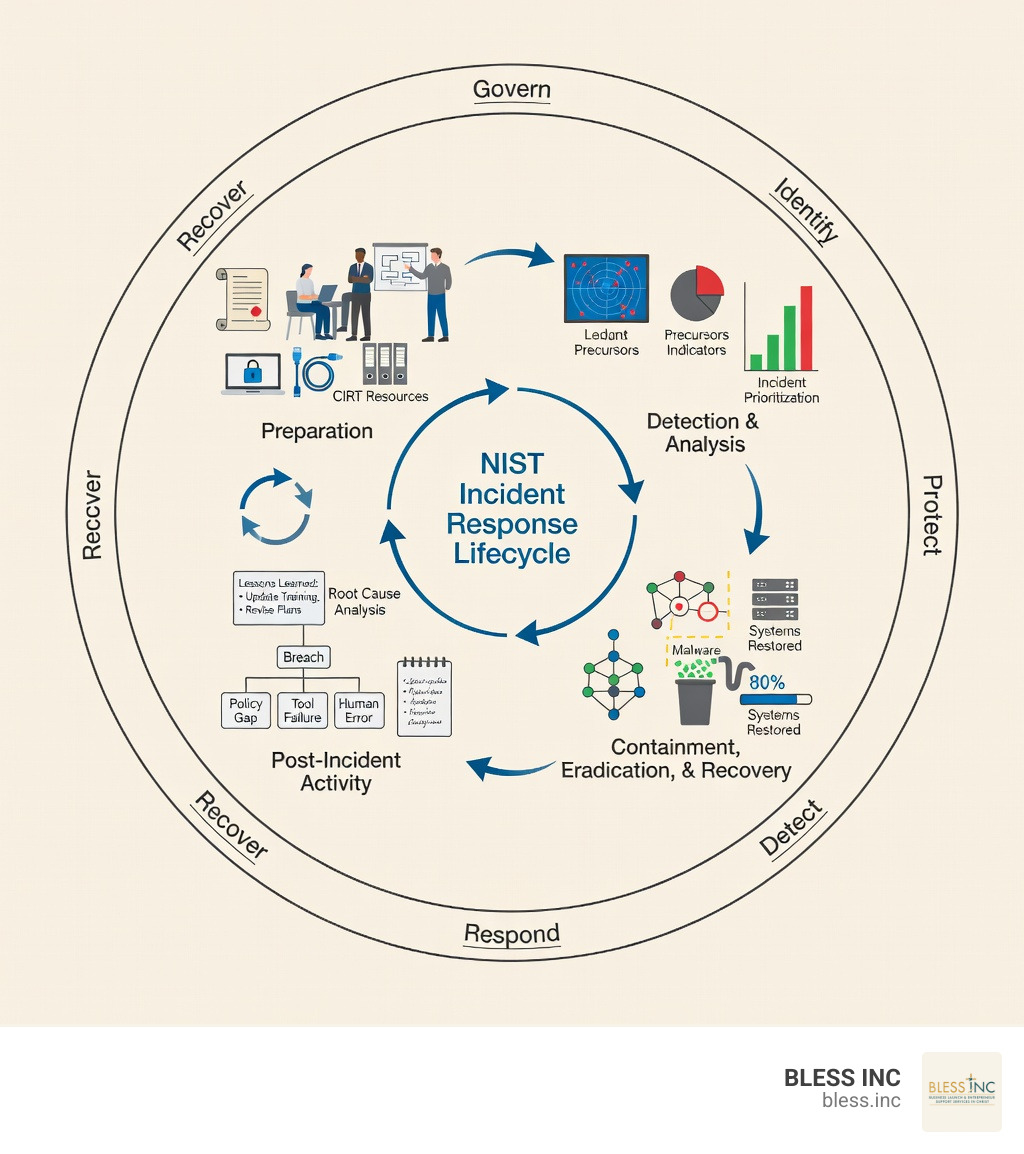
Understanding the NIST Incident Management Framework
When we talk about nist incident management, we are referring to a set of gold-standard guidelines developed by the National Institute of Standards and Technology. Specifically, the NIST SP 800-61 Revision 3 is the foundational blueprint. Released in April 2025, this version represents a significant shift from older versions, moving away from a simple “how-to” guide and toward a strategic integration with broader cybersecurity risk management.
At its core, this framework helps us answer the “Who, What, When, and How” of a breach. It isn’t just about technical fixes; it’s about governance. By using Managed Risk Support, organizations can align their incident response with the Govern function of the NIST Cybersecurity Framework (CSF) 2.0. This ensures that leadership is involved, policies are clear, and the “Identify” and “Protect” functions are working in harmony to prevent incidents before they start.
Integrating NIST SP 800-61 with CSF 2.0
The magic of the newest NIST revision is how it snaps into the CSF 2.0. Think of the CSF 2.0 as the “big picture” strategy, while SP 800-61 provides the tactical “boots on the ground” maneuvers.
The framework alignment focuses on six key functions: Govern, Identify, Protect, Detect, Respond, and Recover. While incident response traditionally lived in the “Respond” category, NIST now emphasizes that effective management requires a risk-based approach across the entire lifecycle. By integrating these, we don’t just react to a virus; we strategically manage the risk that the virus poses to our specific mission and values.
Core Objectives of NIST Incident Handling
Why do we go through all this trouble? We have four primary goals:
- Damage Containment: Stop the bleeding. We want to prevent a small infected laptop from becoming a company-wide ransomware disaster.
- Service Restoration: Get back to work. Our goal is to restore computing services as efficiently as possible to minimize business disruption.
- Evidence Preservation: If we need to involve law enforcement or insurance, we need a clean digital paper trail.
- Vulnerability Mitigation: We don’t just want to fix the problem; we want to make sure it never happens again by patching the hole the attacker used.
The Four Phases of the NIST Incident Response Lifecycle
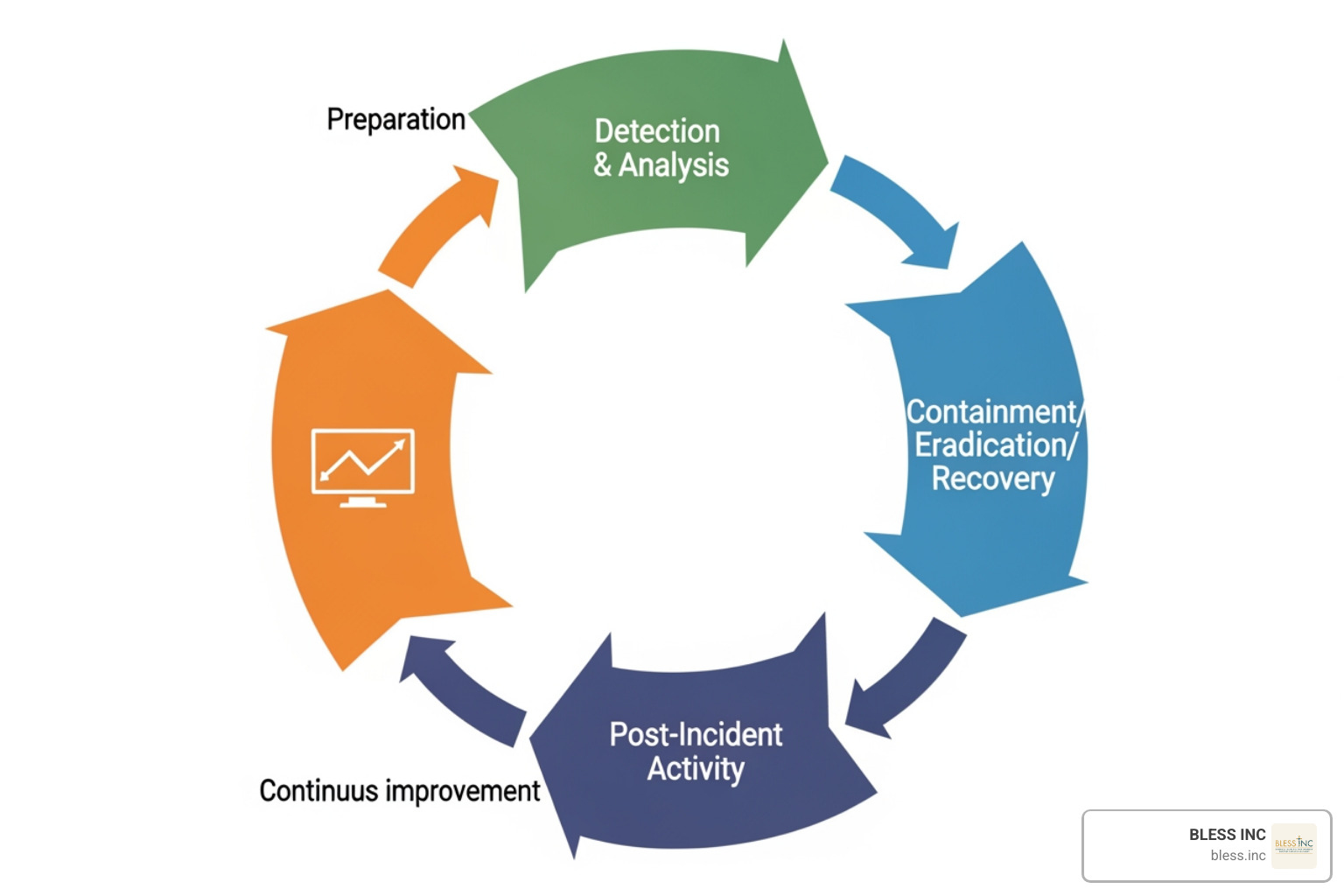
The NIST lifecycle is a circle, not a straight line. Every time we finish responding to an incident, the “lessons learned” feed right back into our preparation for the next one. If you find yourself in the middle of a crisis right now, your first step should be an Emergency Support Request to get expert eyes on the problem immediately.
Phase 1: Preparation and Readiness
Preparation is the most critical phase because it happens when things are calm. If you wait until the screen turns red to think about your plan, you’ve already lost.
First, you need an asset inventory. You can’t protect what you don’t know you have. Second, you need a written plan. We recommend starting with a proven Incident Response Plan Template to define roles and responsibilities.
Finally, gather your “jump kit.” This is a portable set of tools—software, extra hard drives, cables, and even printed contact lists—that your team can grab the second an incident is declared. You should also establish a “baseline” of normal activity so you can actually tell when something looks “weird” on your network.
Phase 2: Detection and Analysis
How do we know we’re under attack? NIST distinguishes between precursors and indicators.
- Precursors are signs that an incident might happen (like a web server log showing a vulnerability scanner).
- Indicators are signs that an incident is happening (like an antivirus alert or a user reporting they can’t open their files).
In this phase, we use SIEM (Security Information and Event Management) alerts and analyze attack vectors to prioritize the incident. Not every alert is a five-alarm fire. We prioritize based on functional impact (is the whole office down?) and information impact (was sensitive data stolen?).
Phase 3: Containment, Eradication, and Recovery
Once we’ve confirmed the threat, we move to stop it.
- Short-term containment: This might mean pulling the network cable on an infected server or blocking a specific IP address at the firewall.
- Eradication: We find every trace of the attacker. This includes deleting malware, disabling breached user accounts, and patching the original vulnerability.
- Recovery: We restore systems from clean backups. We don’t just turn things back on; we monitor them closely to ensure the attacker doesn’t have a “backdoor” to get back in.
Throughout this phase, we must maintain forensic integrity. If we just wipe a drive without taking an image first, we lose the evidence needed to understand what the attacker did.
Phase 4: Post-Incident Activity and Lessons Learned
This is the phase most people skip, yet it’s where the most growth happens. Within two weeks of a major incident, we hold a “lessons learned” meeting. We ask: What happened? How well did the team respond? What information did we need sooner?
We document everything. If you need a framework for this documentation, the California Government IR Plan Template offers a detailed 17-step procedure that includes excellent post-incident reporting structures. This root cause analysis is what turns a bad day into a stronger future.
Structuring Your Incident Response Team (CIRT)
You need a Computer Incident Response Team (CIRT), but it doesn’t have to be ten full-time security geniuses. NIST provides different models based on your needs.
| Model | Description | Best For |
|---|---|---|
| Centralized | A single team handles incidents for the whole organization. | Small to medium businesses with one main location. |
| Distributed | Multiple teams handle specific branches or departments. | Large, geographically dispersed corporations. |
| Coordinated | A central team provides guidance, but local teams do the work. | Organizations with highly specialized departments. |
When deciding on a staffing model, you have to choose between full-time vs. part-time and outsourced vs. in-house. Many smaller organizations find that a hybrid approach—having an internal point of contact supported by Managed Cybersecurity experts—provides the best 24/7 availability without the massive overhead.
Selecting the Right CIRT Model for Your Organization
Choosing a model depends on your organizational size, risk profile, and budget. If you are a faith-driven entrepreneur with a small team, a “virtual” CIRT made of part-time employees and an external partner is usually the most sustainable path. The key is that the team is formalized. Everyone needs to know exactly what their job is when the “Go” signal is given.
Essential Skills for NIST Incident Management
A good incident responder needs more than just technical proficiency. They need:
- Communication Skills: To explain technical disasters to non-technical leaders.
- Legal Knowledge: To understand when a breach requires a HIPAA notification.
- Stress Management: Because incident response is high-pressure work.
- Forensic Capabilities: To preserve evidence without corrupting it.
Why NIST Compliance is Vital for Modern Organizations
Adopting nist incident management isn’t just about being “tech-savvy”—it’s often a legal requirement. If you handle health data, HIPAA regulatory requirements mandate robust incident response. If you take credit cards, PCI-DSS payment security standards apply. And for those of us working as CMMC for defense contractors, having a NIST-aligned plan is non-negotiable.
Strengthening Resilience through NIST Incident Management
Beyond compliance, the framework builds cybersecurity resilience. It shifts your organization from a “hope for the best” mindset to a “prepared for the worst” posture. This proactive defense reduces downtime, protects your reputation, and builds stakeholder trust. When supply chain security is under constant scrutiny, being able to prove you follow NIST standards makes you a more attractive partner.
Supporting Global Compliance Standards
The beauty of NIST is that it plays well with others. If you align with NIST, you are already well on your way to meeting ISO 27001 standards, FISMA mandates, and even GDPR readiness. The framework ensures you have the audit trails and documentation necessary to prove you acted with “due diligence” during a crisis.
Best Practices for Implementing NIST Incident Management
Implementing this doesn’t happen overnight. We recommend a step-by-step approach:
- Policy Development: Get leadership to sign off on a formal Incident Response Policy.
- Team Formation: Identify your CIRT members and their backups.
- Tool Deployment: Invest in automated tools like EDR (Endpoint Detection and Response) or SOAR (Security Orchestration, Automation, and Response).
- Regular Testing: Conduct tabletop exercises. Sit your team down and say, “Okay, the CEO’s email was just hacked. What’s step one?”
If budget is a concern, consider a Cybersecurity Grant Application to help fund the initial setup of your program.
The Role of Information Sharing and Post-Incident Analysis
You don’t have to fight alone. NIST encourages information sharing through ISACs (Information Sharing and Analysis Centers) and reporting to organizations like US-CERT. By sharing threat intelligence (anonymously, of course), we help the entire community stay ahead of new attack patterns. This feedback loop is what makes the global cybersecurity ecosystem stronger.
Frequently Asked Questions about NIST Incident Management
Why is the preparation phase considered the most critical?
Preparation is the foundation. It’s the only phase where you have the luxury of time. By building your plans, training your team, and deploying your tools ahead of time, you ensure that when an incident does happen, your response is fast, clinical, and effective. Speed is the enemy of the attacker.
How often should an Incident Response Plan be updated?
At a minimum, you should review your plan annually. However, you should also update it immediately after any major incident (to include lessons learned) or whenever there are significant changes to your technology stack or the threat landscape.
What is the difference between NIST SP 800-61 Revision 2 and Revision 3?
Revision 2 (from 2012) was more of a technical “how-to” guide. Revision 3 (2025) is a full rewrite that aligns specifically with CSF 2.0. It focuses more on strategic risk management, governance, and the continuous improvement lifecycle rather than just technical checklists.
Conclusion
At BLESS INC, we believe that faith-driven entrepreneurs shouldn’t have to sacrifice their peace of mind to build a successful business. Our mission is to provide the operational support you need—from finance to tech—so you can focus on your calling.
Through our zero-equity accelerator, we offer Managed Cybersecurity Services that help you implement these complex NIST standards without the stress of doing it alone. You retain 100% ownership of your vision, and we provide the “Christ-centered compassion” and technical expertise to keep it safe.
Don’t wait for a crisis to find out if your defenses hold. Start your NIST journey today, and remember: keep calm, follow the framework, and let us help you carry the load.
How to Secure the Best Small Business Risk Support Without Losing Your Mind
Why Small Business Risk Support Can Make or Break Your Business
Small business risk support refers to the tools, programs, strategies, and expert guidance that help business owners identify, manage, and recover from threats to their operations.
Here’s a quick overview of what effective small business risk support looks like:
| Type of Support | What It Covers |
|---|---|
| Financial risk management | Cash flow, debt, revenue concentration |
| Operational support | Equipment failures, supply chain, HR issues |
| Cybersecurity protection | Data breaches, fraud, IT vulnerabilities |
| Disaster resilience planning | Business continuity, emergency funds, recovery |
| Insurance and risk transfer | Liability, property, business interruption coverage |
| Government and community programs | SBA loans, SCORE mentorship, local grants |
Running a small business means wearing every hat – finance, HR, tech, customer service, and more. Most days, risk management falls to the bottom of the pile.
But here’s the hard truth: only 30% of small business owners have a business continuity plan in place. And about 25% of businesses never reopen after a major disaster.
That’s not a statistic about bad luck. That’s a gap in preparation.
Risks don’t just come from threats. They can come from opportunities too – a new hire, a big client, rapid growth. Without a clear support system, even good news can create dangerous exposure.
For faith-driven entrepreneurs already stretched thin, this isn’t just a business problem. It’s a mission problem. When your business is your calling, protecting it is an act of stewardship.
This guide breaks down exactly how to build strong, practical risk support for your small business – without overwhelm and without losing your mind.
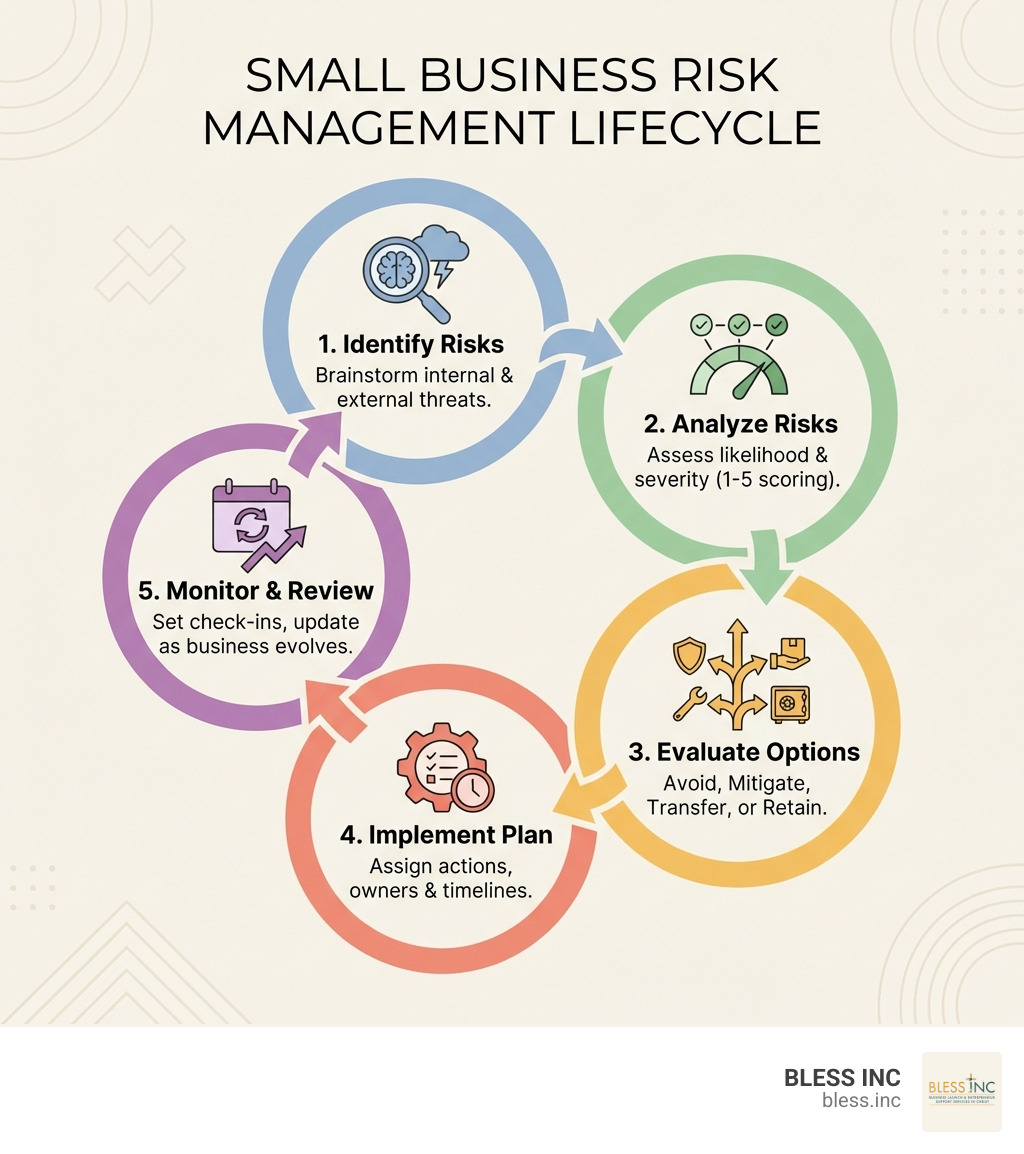
What is Risk Management and Why is it Essential?
At its heart, risk management is the practice of identifying and analyzing loss exposures and taking proactive steps to minimize the financial impact. It isn’t just about preventing bad things from happening; it’s about ensuring that when the unexpected occurs, your business has a soft place to land.
For a small business, risk management is essential because it:
- Saves Time in Decision-Making: When you have a plan, you don’t have to panic-search for solutions in the middle of a crisis.
- Increases Success Probability: Businesses that anticipate hurdles are more likely to clear them.
- Protects Your Mission: Whether you are providing a service or creating a product, risk management ensures your work continues.
According to the Business Resilience Guide: Reducing Risks and Building on Strengths, resilience isn’t just surviving a disaster—it’s about building on your existing strengths to reduce future vulnerabilities. We believe that every entrepreneur deserves managed risk support that allows them to focus on their calling rather than their fears.

The 6 Pillars of Small Business Risk Support
To effectively manage a business, we have to look at risks through two lenses: internal (things we can mostly control) and external (things that happen to us).
| Risk Category | Type | Examples |
|---|---|---|
| Internal | Operational, Financial | Faulty equipment, poor cash flow, employee turnover |
| External | Hazard, Strategic | Natural disasters, market shifts, new regulations |
We categorize these into six specific pillars to help you organize your small business risk support strategy.
1. Financial Risk
This involves anything that threatens your cash flow or capital. Common pitfalls include high debt-to-equity ratios (the general guideline is to stay below 40-50%) or relying too heavily on a single large customer. If that one client leaves, your revenue vanishes.
2. Strategic Risk
Strategic risks are often voluntarily assumed for greater returns—like expanding into a new market. However, if the market shifts or a competitor undercuts your pricing, the strategy can backfire. Proactive managed-strategic-support helps you evaluate these moves before you leap.
3. Reputational Risk
A single bad review or a public misunderstanding can tarnish years of hard work. For small businesses, reputation is heavily tied to online presence and customer service quality.
4. Hazard Risk
These are “acts of God” or accidents—building fires, storm damage, or an employee getting injured on the job. These are typically managed through insurance and safety protocols.
5. Operational Risk
Operational risks are the “gears” of your business grinding to a halt. This could be a server outage, a delivery van breaking down, or an administrative error that leads to a missed tax deadline. Improving your internal systems through managed-process-improvement is the best defense here.
6. Cybersecurity Risk
With 88% of small business owners feeling vulnerable to cyber-attacks, this is no longer just a “big tech” problem. Data breaches and fraud can be devastating for a small firm.
Proven Strategies for Financial and Strategic Risk Support
To handle financial risk, we recommend diversifying your client base and maintaining 3–12 months of emergency funds. Keep a close eye on your debt-to-equity ratio and ensure your accounting duties are separated (one person shouldn’t handle the books and the bank deposits) to prevent internal fraud.
For strategic risks, don’t go it alone. Use SWOT analysis (Strengths, Weaknesses, Opportunities, Threats) to vet every major decision. If you’re feeling overwhelmed by the technicalities, managed-process-improvement can help streamline your operations so you have the mental bandwidth to think strategically.
Navigating Cybersecurity and Operational Risk Support
Operational resilience starts with redundancy. If your delivery van breaks down, do you have a backup? If your main supplier closes, do you have a secondary contact?
In the realm of cybersecurity, the basics go a long way:
- Use multi-factor authentication (MFA).
- Backup your data off-site (cloud and physical).
- Train employees to recognize phishing emails.
If managing IT feels like a foreign language, leveraging managed-cybersecurity and managed-technology ensures your digital assets are protected by experts while you focus on growth.
A Step-by-Step Framework to Identify and Prioritize Risks
You can’t manage what you haven’t identified. We suggest gathering your team for a brainstorming session to map out potential threats.
A great resource for this is the Prepare and Protect: The Small Business Owner’s Guide to Identifying and Managing Risks | SCORE.
The Prioritization Formula
Not all risks are created equal. To prioritize them, use this simple scoring system:
Likelihood (1-5) x Severity (1-5) = Risk Score.
For example:
- Tornado: Likelihood 2, Severity 5 = Score 10.
- One Bad Review: Likelihood 4, Severity 2 = Score 8.
- Data Breach: Likelihood 3, Severity 5 = Score 15.
Address the highest scores first.
Creating Your Comprehensive Risk Management Plan
Once you’ve identified the risks, you have four ways to handle them:
- Avoidance: Stop the activity that causes the risk (e.g., stopping a high-risk service line).
- Mitigation: Reduce the impact (e.g., installing a sprinkler system or improving managed-human-resources training).
- Transfer: Pass the risk to someone else (e.g., buying insurance or outsourcing a risky task).
- Retention: Accept the risk and budget for it (e.g., self-insuring for small equipment repairs).
Our strategy-development services can help you document these choices into a formal Business Continuity Plan (BCP).
Ongoing Monitoring and Adapting to Change
Risk management isn’t a “one and done” task. The world changes—new laws are passed, new technologies emerge, and your business grows. We recommend a quarterly review cycle to update your BCP.
Leaders need support to stay on top of these shifts. Our managed-leader-support provides the accountability and expertise needed to ensure your risk plan stays relevant as you scale.
Building Resilience Through Insurance and External Resources
Insurance is the primary tool for transferring risk. While it costs money upfront, the Insurance Institute notes that every $1 spent on risk reduction saves $6 in future losses.
Key coverages to consider:
- General Liability: Protects against slip-and-fall accidents.
- Property Insurance: Covers your physical location and equipment.
- Business Interruption Insurance: Replaces lost income if you’re forced to close due to a covered disaster.
- Cyber Insurance: Helps recover costs from data breaches.
Beyond insurance, utilize the Small Business Resilience Hub | SCORE for templates and mentorship.
Leveraging Government and Community Support Programs
You don’t have to build your safety net alone. Several programs offer specialized small business risk support:
- SBA Disaster Assistance: Provides low-interest loans for physical and economic injury after a disaster.
- FDIC Insurance: Ensures your business deposits are protected up to $250,000.
- NYC SBS Workshops: The Business Preparedness and Resiliency Program offers free webinars and even grants for risk assessments in the New York area.
- Travelers SBRE: This program provides risk management workshops and microloans specifically for women-, minority-, and veteran-owned businesses.
Small Business Risk Support for Faith-Driven Entrepreneurs
At BLESS INC, we understand that for faith-driven entrepreneurs, business is more than a paycheck—it’s a calling. However, the “lonely at the top” feeling can make risk management feel like a spiritual burden rather than a strategic task.
We provide a zero-equity accelerator that offers operational support in finance, HR, and tech. Our goal is to help you embrace “prayerful risk”—the kind of risk that comes from following God’s lead—while we handle the “operational risk” that keeps you up at night.
With our tiered, sliding-scale pricing, we ensure that even early-stage founders have access to high-level risk support without giving up ownership of their vision. We focus on Christ-centered compassion, ensuring that your business practices reflect your values while remaining resilient.
Frequently Asked Questions about Small Business Risk Support
What is the most common risk faced by small businesses?
While it varies by industry, operational and financial risks are the most persistent. Specifically, cash flow mismanagement and “key person risk” (where the business depends too heavily on the owner) are the most frequent causes of small business failure.
How does insurance help in transferring business risks?
Insurance acts as a contract where you pay a premium to a company in exchange for them assuming the financial burden of a specific loss. Instead of having to pay $100,000 out of pocket for a fire, you pay a monthly fee, and the insurance company covers the catastrophic cost.
What percentage of businesses fail to reopen after a disaster?
According to FEMA, approximately 25% of businesses do not reopen following a major disaster. This is often because they lack a business continuity plan or sufficient “business interruption” insurance to cover expenses while they are closed for repairs.
Conclusion
Securing the best small business risk support doesn’t mean you have to become an expert in everything from cybersecurity to commercial law. It means knowing where to find the right tools and partners to help you build a resilient foundation.
By identifying your vulnerabilities, prioritizing them with a simple scoring system, and leveraging resources like the SBA and BLESS INC, you can move from a state of constant “firefighting” to a state of operational peace.
Risk is an inherent part of the entrepreneurial journey. It is the price we pay for the opportunity to create something new. But with the right support, you can navigate those risks with confidence and stewardship.
Secure your future with managed risk support and turn your business into a resilient vessel for your mission.
Don’t Go It Alone: A Guide to Affordable Entrepreneurial Support
Understanding Sliding Scale Entrepreneur Support
When we talk about sliding scale entrepreneur support, we are referring to a pricing model that adjusts the cost of services based on an individual’s or organization’s ability to pay. Unlike traditional fixed-price models, this approach recognizes that while the value of the service remains high, the financial capacity of entrepreneurs varies wildly.
In business acceleration, many models demand high upfront fees or, more commonly, a percentage of your company’s equity. For a faith-driven founder, giving up ownership can feel like compromising the vision God gave you. That is why we focus on Accelerate Pricing that prioritizes accessibility over equity. By using a sliding scale, we can provide deep operational support—covering finance, HR, tech, and admin—without requiring you to sign over a piece of your calling.
This model is also a response to systemic inequities. We know that the playing field isn’t level; factors like racial discrimination, the gender pay gap, and lack of access to intergenerational wealth create significant barriers for many talented founders. According to a survey by Accenture, 63% of customers prefer to buy from companies that reflect their personal values and take a stand on social issues. Implementing a sliding scale is a tangible way to live out those values of economic justice and Christ-centered compassion.
How Sliding Scale Differs from Standard Discounts
It is easy to confuse a sliding scale with a simple coupon code or a “pay-what-you-can” (PWYC) model, but there are distinct differences:
- Standard Discounts: These are usually temporary, marketing-driven, and offered to everyone regardless of need. They don’t address long-term accessibility.
- Pay-What-You-Can: While noble, PWYC often lacks a floor or a suggested structure, which can make it difficult for a business to remain sustainable. It relies entirely on the client’s whim.
- Sliding Scale: This is a structured, value-based approach. It involves “intentional generosity.” We set specific tiers that reflect different financial realities. It ensures that those with greater means help subsidize the costs for those with fewer resources, creating a balanced ecosystem where everyone pays a “meaningful” amount relative to their situation.

The Role of Equity in Sliding Scale Entrepreneur Support
In the startup world, “equity” usually refers to shares in a company. However, in the context of social impact, equity refers to fairness and justice. Sliding scale entrepreneur support acts as a bridge to close the gap created by marginalization.
Systemic barriers often mean that minority business owners or those from disadvantaged backgrounds have less “safety net” capital. If a coaching program or an operational audit costs $5,000, that might be a “sacrifice” for one founder (meaning they skip a vacation) but a “hardship” for another (meaning they can’t pay their staff). By removing the requirement to give up company equity and replacing it with an equitable sliding scale, we allow entrepreneurs to retain 100% ownership of their ventures while still receiving the high-level expertise usually reserved for venture-backed Silicon Valley firms.
Designing Your Equitable Pricing Tiers
Creating a sliding scale requires more than just picking random numbers. It requires a thoughtful look at how different tiers can support a diverse community. Many successful practitioners use neutral or nature-themed names to remove the “stigma” of paying less. For instance, water-themed tiers like “Stream,” “River,” and “Ocean” can signify different levels of flow and resource.
At BLESS INC, we provide a comprehensive Accelerator Tier Comparison to help founders see where they fit. A well-designed scale often includes a “Redistribution Rate”—a top-tier price that is slightly above the market rate. This allows those who are thriving to intentionally invest in the success of others in the community.
[TABLE] Comparison of Sliding Scale Tiers
| Tier Name | Financial Situation | Typical Indicators |
|---|---|---|
| Redistribution | Thriving / High Surplus | Owns home, has investments, high household income ($125k+), business is profitable. |
| Full Cost | Stable / Sustainable | Meets all needs, has some savings, can afford occasional travel, business covers its own costs. |
| Solidarity | Growing / Modest | Income covers basic needs but savings are thin ($40k-$70k), business is in early revenue stages. |
| Access | Emerging / Striving | Facing financial “hardship,” may qualify for public assistance, business is in formation or pre-revenue. |
Self-Guided Criteria for Choosing the Right Tier
We believe that entrepreneurs are the best judges of their own financial situations. To help you choose, we encourage a moment of honest reflection. This isn’t just about your bank balance today; it’s about your overall access to resources.
- Sacrifice vs. Hardship: If paying for support means you have to skip a few dinners out or delay a luxury purchase, that is a sacrifice. If paying for support means you might not be able to pay rent or buy groceries, that is a hardship. Sliding scales are designed to move people from hardship to a place where they can eventually make a sustainable sacrifice for their growth.
- Safety Nets and Wealth: Do you have a family that could help you if your business failed? Do you own your home? Do you have a retirement account? These are indicators of privilege that suggest you should select a higher tier to leave the lower spots for those without such cushions.
- Earning Potential: A founder with a Master’s degree and ten years of corporate experience has a different “earning potential” than a first-generation immigrant starting their first venture, even if both currently have $0 in the bank.

Implementing Sliding Scale Entrepreneur Support in Different Business Models
While we focus on operational support like finance and HR, the sliding scale entrepreneur support model works across various industries:
- Online Courses: Platforms like Teachable allow you to create different “coupons” or tiers. You can cap the number of “Access” seats to ensure the course remains profitable.
- Coaching: Many coaches offer two pro bono spots or three “reduced rate” spots per quarter.
- In-Person Services: For workshops, you might offer a “Community Love” rate for local residents who are being displaced by gentrification.
- Operational Support: This is where we thrive. By offering tiered pricing for tech setup or HR auditing, we ensure that a 2-person nonprofit gets the same quality of “back-office” excellence as a 50-person corporation.
Balancing Accessibility with Business Sustainability
One of the biggest fears entrepreneurs have about offering a sliding scale is: “Will I go broke?” The answer is no, provided you set clear boundaries. You cannot pour from an empty cup. To serve others with Christ-centered compassion, your own business must be healthy.
We recommend setting “enrollment caps.” For example, you might decide that your team can handle ten projects a month: two at the “Access” rate, five at the “Full Cost” rate, and three at the “Redistribution” rate. This ensures your average revenue per client stays above your break-even point.

Avoiding Common Pitfalls and Misuse
Even with the best intentions, sliding scales can face challenges. One common issue is “temporary scarcity.” This happens when someone who actually has significant wealth (e.g., a large inheritance or a high-earning spouse) chooses the lowest tier because their current business bank account is low. This takes a spot away from someone with chronic scarcity.
Another pitfall is “reactive discounting.” This happens when a client hesitates on a price, and the entrepreneur panics and offers a lower rate on the spot. This isn’t a sliding scale; it’s devaluing your work. A true sliding scale is a pre-planned, transparent system.
To prevent “free-rider” issues, it is important to communicate that people who pay less often show up with less “skin in the game.” By ensuring even the lowest tier requires some financial commitment, you foster a sense of mutual respect and accountability.
Legal, Tax, and Marketing Considerations
Offering a sliding scale isn’t just a “nice thing to do”; it can have real business benefits. From a marketing perspective, it builds a “values-aligned” brand. When you are transparent about your pricing, you attract clients who care about equity and community.
From a financial standpoint, you must track everything. When you accept a client at a lower tier, track the difference between that rate and your “Standard” rate. While the IRS generally doesn’t allow you to deduct “lost income” as a charitable contribution, there are specific instances where providing services to 501(c)(3) nonprofits at a discount may have tax implications for charitable services. Always consult with an accountant to see how these “charitable hours” might impact your specific filings.
To help you plan, we offer a Cost Estimator tool. This helps you understand your own “floor”—the absolute minimum you need to charge to keep your lights on—so you can design a scale that is both generous and sustainable.
Communicating Full Value at Every Level
A common mistake is treating lower-tier clients like “discount” clients. In our model, every entrepreneur receives the same “Gold Standard” of service. Whether you are at the “Solidarity” or “Redistribution” level, our commitment to your HR, tech, and financial health remains the same.
Transparency is key. Your sales page should clearly state: “The value of this service is $X. We offer it at $Y for those in Tier 3 to ensure accessibility.” This ensures the client knows they are receiving a high-value asset, which encourages them to take the work seriously and implement the strategies provided.
Frequently Asked Questions about Sliding Scale Support
How do I know which tier I qualify for?
We suggest a holistic self-assessment. Don’t just look at your monthly revenue. Consider your “safety net.” If you own a home, have a college degree, or have family you could turn to in an emergency, you likely belong in a middle or upper tier. If you are currently struggling to meet basic needs or have significant debt, the lower tiers are there for you. Be honest with yourself and the community; when those who can pay more do so, the whole system stays upright.
Will offering a sliding scale devalue my services?
Only if you don’t communicate the “Full Value.” Always list the market price alongside the sliding scale options. By framing it as “Intentional Generosity” rather than a “Discount,” you maintain your professional integrity. You are making a strategic choice to invest in your community, which is a sign of business strength, not weakness.
Can I limit the number of sliding scale spots available?
Absolutely. In fact, for business sustainability, you should. Most service providers cap their lowest-tier spots. This prevents burnout and ensures you have the resources to provide high-quality support to everyone. You can also use “seasonal expansion,” offering more sliding scale spots during specific times of the year (like year-end or during a launch) to help more people get started.
Conclusion
At BLESS INC, we believe that no entrepreneur should have to walk their journey alone just because they lack a massive startup budget. Our zero-equity accelerator is built on the foundation of Christ-centered compassion, providing the essential “back-office” support—Finance, HR, Tech, and Admin—that every business needs to thrive.
By utilizing sliding scale entrepreneur support, we ensure that you retain 100% ownership of your vision while gaining the operational excellence required to scale. We are here to be your partners in growth, helping you move from a place of “doing it all” to a place of “leading it all.”
If you are ready to take the next step in your journey with a team that values your mission as much as you do, we invite you to discover our services and see how our tiered pricing can work for you.
The Best Biblical Finance Business Services for Modern Ministries
Why Biblical Finance Business Services Are Essential for Faith-Driven Entrepreneurs
Biblical finance business services combine professional financial expertise with Scripture-based principles to help faith-driven businesses manage money, make investments, and plan for the future — all in a way that honors God.
Here is a quick look at what these services typically include:
- Stewardship planning – Managing resources as a trustee of God’s wealth, not an owner
- Biblically Responsible Investing (BRI) – Screening investments to align with biblical values
- Faith-aligned bookkeeping and payroll – Day-to-day financial operations guided by integrity
- Legacy and estate planning – Building multigenerational impact, not just personal wealth
- Business consulting – Strategic advice rooted in biblical wisdom like Proverbs 15:22
Running a ministry or faith-driven business is not easy. You are often handling finance, HR, tech, and admin all at once — while trying to lead with purpose and stay true to your calling.
The financial pressure is real. But so is the guidance available to you.
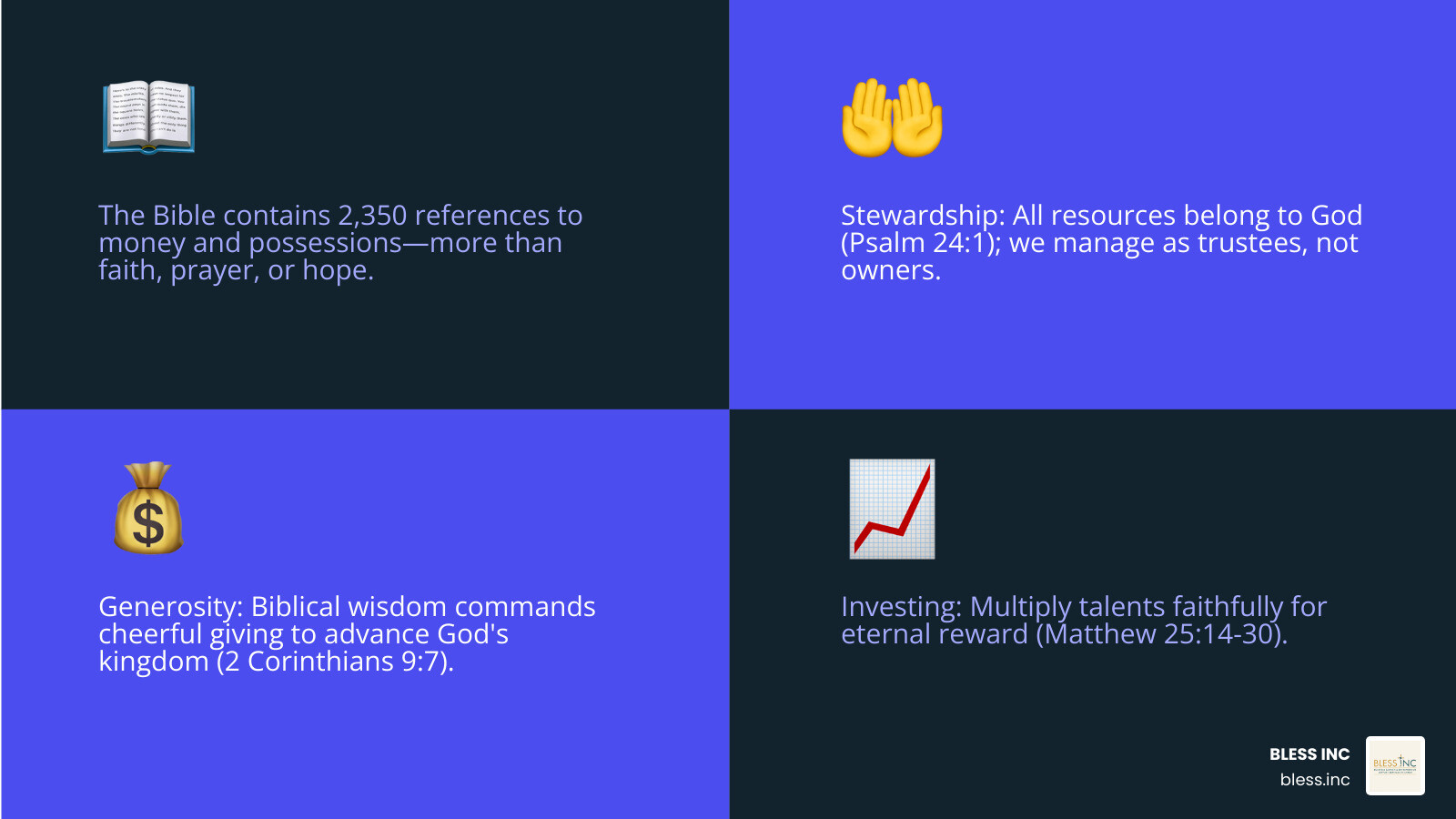
The Bible contains 2,350 references to money and material things. That is more than almost any other topic in Scripture. God has a lot to say about how we earn, spend, save, give, and invest. Biblical finance business services exist to translate that wisdom into practical tools for modern ministries and entrepreneurs.
“God’s Word has incredible wisdom in the area of finances — covering debt, budgeting, investing, stewardship, priorities, and giving.”
This is not just about avoiding “bad” investments or tithing correctly. It is about building a business where every financial decision reflects your values, serves your mission, and creates lasting kingdom impact.
Defining Biblical Finance Business Services
When we talk about biblical finance business services, we are describing a framework that views capital not as an end, but as a tool for a higher calling. Traditional financial services focus almost exclusively on accumulation—how much can you get, and how fast? Biblical models shift the focus to stewardship.
In this context, stewardship means acknowledging that God owns it all (Psalm 24:1). We are simply managers or “trustees” of the resources placed in our hands. This perspective changes everything from how we handle a surplus to how we navigate a lean quarter. It requires an eternal perspective, looking past this year’s P&L statement to the lasting impact our business has on employees, customers, and the community.
Resources like The Business Bible highlight that Scripture contains a coherent, divine blueprint for economics and work. For example, the “talent” mentioned in the Parable of the Talents was actually a unit of currency worth roughly $2.5 million in today’s gold prices. This suggests that Jesus often taught using the language of capital allocation and investment.
To help entrepreneurs navigate these complexities, we offer Managed Strategic Support, ensuring that your high-level business decisions are filtered through a lens of biblical wisdom and operational excellence.
How biblical finance business services Differ from Traditional Models
The primary difference lies in the definition of success. Traditional models measure success by “The Midas Touch”—the ability to turn every venture into gold. However, as the Greek myth warns, Midas eventually realized his “gift” was a curse that prevented him from enjoying the things that truly mattered.
Biblical services prioritize:
- Kingdom-Centric Goals: Profit is necessary for sustainability, but the ultimate goal is human flourishing and Gospel advancement.
- Generosity as a Discipline: Giving is not an afterthought or a tax strategy; it is a core operational priority that reflects God’s generosity.
- Contentment: Working hard and seeking growth while remaining content in God’s provision, rather than being driven by the “love of money” (1 Timothy 6:9-10).
Through Leadership Mentoring, we help founders transition from being “self-led” to “God-led,” ensuring their identity is rooted in Christ rather than the ups and downs of the market.
Foundational Principles of Faith-Aligned Finance
Several key scriptures form the “Constitution” of biblical finance:
- Proverbs 15:22: “Plans fail for lack of counsel, but with many advisers they succeed.” This underscores the importance of seeking expert, faith-aligned advice.
- Colossians 3:23: “Whatever you do, work at it with all your heart, as working for the Lord, not for human masters.” This sets the standard for technical excellence and integrity.
- The Parable of the Talents: Found in Matthew 25:14-30, this story teaches that we are expected to multiply the resources we are given. Doing nothing with God’s resources out of fear is not considered faithful stewardship.
Core Pillars of Faith-Aligned Financial Management
To build a business on a firm foundation, entrepreneurs must look beyond simple accounting. They must address how their capital interacts with the world.
One of the most significant pillars is Biblically Responsible Investing (BRI). This involves actively screening out companies that profit from activities that dishonor God—such as abortion, pornography, gambling, or human trafficking—and seeking out companies that promote life and blessing.
Another pillar is Legacy Planning. This isn’t just about writing a will; it’s about creating a “stewardship blueprint” for the next generation. It ensures that the business you’ve built continues to serve the Kingdom long after you’ve stepped away. We support this through Managed Risk Support, protecting your mission from legal and financial pitfalls that could jeopardize your long-term legacy.
[TABLE] Comparing BRI vs. Traditional Investing
| Feature | Traditional Investing | Biblically Responsible Investing (BRI) |
|---|---|---|
| Primary Goal | Maximize ROI at any cost | Honor God while seeking reasonable returns |
| Screening | Focuses on financial metrics only | Filters for moral and ethical alignment |
| View of Profit | Profit is the ultimate end | Profit is a tool for stewardship |
| Corporate Impact | Neutral on social issues | Actively avoids funding harmful industries |
| Perspective | Short-term/Quarterly focus | Eternal/Generational focus |
Integrating biblical finance business services into Daily Operations
It is easy to talk about high-level principles, but the real test of biblical finance happens in the “boring” stuff: the ledger and the payroll.
Integrating faith into daily operations means practicing radical honesty in your Managed Bookkeeping. It means paying vendors on time, being transparent with tax authorities, and ensuring your employees are treated with the dignity they deserve as image-bearers of God.
Ethical payroll is another critical area. For ministries, this includes navigating complex clergy housing allowances and tax nuances. For businesses, it means providing fair compensation that allows your team to provide for their families and experience the “joy of work.”
The Strategic Value of biblical finance business services for Growth
Growth is not a dirty word in the Bible. In fact, many parables celebrate the “increase” of resources. However, the way you grow matters.

Many entrepreneurs feel they have to choose between keeping 100% of their mission and getting the capital they need to scale. Traditional venture capital often demands equity—a “piece of the pie”—which can lead to a dilution of the original vision.
We believe there is a better way. Our zero-equity accelerator provides the operational support you need without taking ownership of your calling. By using a tiered, sliding-scale pricing model, we ensure that Accelerate Growth is accessible to ministries and startups at every stage of their journey.
Aligning Investments with Ministry Mission
For many ministries, “investments” aren’t just about stocks and bonds; they are about how you deploy your capital to achieve your mission. This is often called Impact-Focused Capital.
If your ministry focuses on family restoration, your business investments and operational spending should reflect that. This might mean choosing vendors who support family-friendly policies or using Managed Documents to ensure all your contracts and agreements reflect Christian values of grace and truth.
Selecting a Provider for Your Ministry or Business
Not every financial advisor who calls themselves “Christian” operates with the same depth of biblical integration. When looking for biblical finance business services, you should look for specific qualifications.
One of the gold standards is the Certified Kingdom Advisor (CKA) designation. This requires rigorous coursework, a commitment to a code of ethics, and a demonstrated ability to integrate biblical wisdom into financial planning.
Furthermore, you want a provider who acts as a fiduciary. This is a legal and ethical commitment to put the client’s best interests first. When many “advisors” are actually salespeople for high-commission products, a fiduciary relationship is a breath of fresh air. It aligns perfectly with the biblical call to integrity and humility. We provide this level of dedicated care through our Managed Leader Support.
Qualifications for Faith-Driven Financial Partners
When interviewing a potential partner, consider these two categories:
- Theological Alignment: Do they understand stewardship vs. ownership? Will they pray with you when you face a financial crisis? Do they view their work as a spiritual calling?
- Technical Excellence: Faith is not an excuse for mediocrity. Your provider should be experts in Managed Technology, tax law, and market dynamics. As Nicholas Leone noted in his research, the Bible contains the oldest recorded valuation methods and pillars of asset management—we should be just as sharp as the secular world, if not sharper.
Frequently Asked Questions about Biblical Finance
What is Biblically Responsible Investing (BRI)?
BRI is an investment approach that evaluates companies based on their alignment with biblical values. It typically involves “negative screening” (avoiding companies involved in abortion, pornography, gambling, etc.) and “positive screening” (seeking out companies that treat employees well, practice environmental stewardship, and create life-enhancing products).
How does biblical stewardship apply to business debt?
The Bible generally warns against debt, describing the borrower as a “slave to the lender” (Proverbs 22:7). While not strictly forbidden, biblical finance services often focus on debt reduction and maintaining high levels of liquidity. The goal is financial freedom, allowing the business to pivot quickly when God calls it into a new direction without being “chained” by interest payments.
Can non-religious businesses use these services?
Absolutely. While the foundation is biblical, the principles—such as avoiding debt, practicing radical honesty, seeking wise counsel, and planning for the long term—are universal. Many secular business owners find that biblical finance business services provide a level of stability and integrity that is hard to find in traditional models.
Conclusion
At BLESS INC, we know that your business or ministry is more than just a way to make a living; it is your “living sacrifice” (Romans 12:1). You shouldn’t have to navigate the complexities of finance, HR, and tech alone.
We offer a zero-equity accelerator designed specifically for faith-driven entrepreneurs. Our tiered, sliding-scale pricing ensures you get the operational support you need—from bookkeeping to leadership mentoring—while retaining 100% ownership of your vision.
If you are ready to align your business operations with your faith and experience the peace that comes from true stewardship, we invite you to Discover Our Services. Let’s build something that lasts for eternity, together.
Scaling Up on a Sliding Scale: Why Your Budget Shouldn’t Stop Your Big Idea
Why Your Budget Shouldn’t Disqualify You from Business Acceleration
A sliding scale business accelerator is a program that adjusts its fees, equity requirements, or investment terms based on a startup’s ability to pay — so founders at different financial starting points can access the same quality of support.
Here’s what that means in practice:
- Low-revenue founders pay less (or give up less equity) to participate
- Higher-revenue founders pay more, helping offset costs for others
- Everyone gets access to mentorship, networks, and structured growth support
- No single fixed price locks out founders who are capital-constrained
Most business accelerators follow a familiar playbook: take 5–10% equity, offer $20,000–$150,000 in seed funding, run a 3–6 month cohort, and close with a demo day. It’s a proven model — but it’s built for founders who already have traction, connections, and capital runway.
That leaves a huge group behind.
If you’re a faith-driven entrepreneur managing finance, HR, tech, and admin on your own — with limited cash flow and a big vision — the traditional accelerator model can feel like a door that’s just slightly out of reach. You need the mentorship and structure an accelerator provides, but the price of entry is the problem.
That’s exactly where the sliding scale model changes the equation.
Instead of one fixed barrier, it creates a range. Founders self-select into a tier that reflects their real financial situation — not just their annual revenue, but factors like debt, dependents, business stage, and even systemic disadvantages they’ve faced. As one entrepreneurship program puts it: “You are the best judge of your ability to pay, no questions asked.”
The result? Accelerator access becomes less about how much money you already have, and more about how far you’re willing to go.
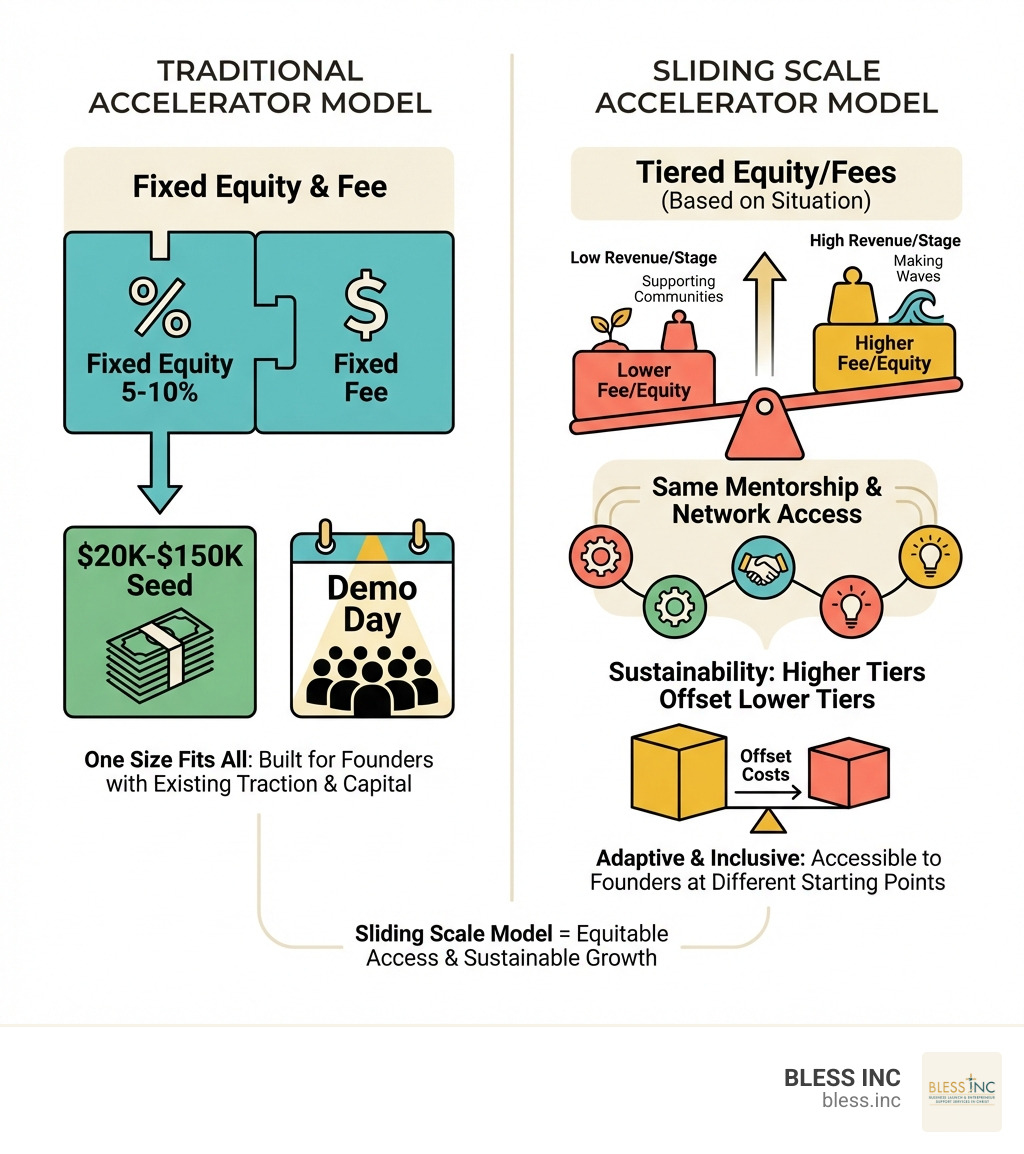
Understanding the Sliding Scale Business Accelerator Model

To understand how a sliding scale business accelerator works, we first need to look at what it’s accelerating. A business accelerator is a fixed-term, cohort-based program that includes mentorship and educational components. Most culminate in a public pitch event or “demo day.”
Traditional models are often rigid. They ask for a specific percentage of your company in exchange for a set amount of cash. But what if you don’t want to sell your “baby” just yet? Or what if you are building a Zero Equity Accelerator model where the goal is to keep 100% ownership?
This is where the sliding scale comes in. It is a variable pricing structure that adjusts charges based on a customer’s ability to pay or their current business stage. This means the cost of the program—whether paid in fees or structured via investment terms—is not a “one-size-fits-all” barrier.
Most accelerators require you to have at least a Minimum Viable Product (MVP). As Eric Ries famously defined it, an MVP is the version of a new product that allows a team to collect the maximum amount of validated learning with the least effort. Once you have that MVP, you’re ready to scale. The sliding scale ensures that your current bank balance doesn’t dictate whether you get the help needed to turn that MVP into a market leader.
How a sliding scale business accelerator structures fees and equity
In a sliding scale business accelerator, the financial “ask” is typically broken down into tiers. Unlike the fixed 7% equity taken by many top-tier US accelerators, a sliding scale might offer a range of options:
- Revenue-Based Tiers: If your startup is generating $0–$50k annually, your program fee might be subsidized. If you’re at $150k–$4M, you might pay a “Full Cost” or “Redistribution” rate.
- Equity Percentages: Some models might offer a “sliding equity” scale. A founder might choose to give up 2% equity for a smaller investment or 10% for a larger capital injection and more intensive support.
- Structured Funding Stages: We often see programs that use a three-stage funding process. They don’t give you everything at once; they validate your progress at each step, which is a form of “scaling” the support as the business grows.
| Feature | Fixed Equity Model | Sliding Scale Model |
|---|---|---|
| Equity Taken | Usually 5–10% (Fixed) | 0% to Variable % |
| Program Fees | Often free (but high equity cost) | Tiered based on ability to pay |
| Accessibility | High barrier (1-3% acceptance) | Inclusive of diverse financial backgrounds |
| Ownership | Diluted immediately | Often 100% retained (in zero-equity models) |
The impact of a sliding scale business accelerator on diversity and inclusion
Economic justice is at the heart of the sliding scale. We recognize that not every founder starts on a level playing field. Some have access to generational wealth, while others are supporting dependents or dealing with significant debt.
By using equitable pricing strategies, an accelerator can account for systemic privileges like race, gender, and class. Instead of a scholarship model—which can often feel like a “handout” or involve invasive applications—the sliding scale relies on trust and self-selection.
When we look at an Accelerator Tier Comparison, we see that this model allows underrepresented founders to enter the ecosystem without the “cliff” of high initial costs. It’s about dismantling cost barriers for those working in the “frontline” of their communities, ensuring that a lack of initial capital doesn’t mean a lack of future impact.
Why Startups Choose Flexible Acceleration Models
Why would a founder choose a sliding scale business accelerator over a big-name, fixed-equity program? For many of the faith-driven entrepreneurs we work with, the answer is simple: stewardship and mission.
When you’ve spent years bootstrapping your vision, giving away 7-10% of your company for a three-month program can feel like poor stewardship of the gift you’ve been given. Flexible models allow you to keep your hands on the wheel. You can find Accelerate Pricing that fits your current cash flow, rather than sacrificing your future cap table.
Benefits for early-stage ventures
For a startup in its infancy, every dollar counts. Choosing a sliding scale model provides:
- Mentorship Without “Taxation”: You get the same high-level advice from industry experts without the permanent equity “tax” on your business.
- Resource Allocation: Instead of a massive upfront fee, you can put your capital toward product development or hiring your first employee.
- Tailored Support: Programs focused on Accelerate Growth often provide modular support. You only pay for (and engage with) the resources you actually need at your current stage.
Comparing sliding scales to traditional fixed-fee programs
Traditional fixed-fee programs can be just as exclusionary as equity-heavy ones. If an accelerator charges a flat $10,000 fee, a founder with $1M in the bank barely notices, while a founder living paycheck-to-paycheck is locked out.
In contrast, our Accelerate Scale approach ensures that the “energetic exchange” is fair. The goal is to move away from “standardization” and toward “equity.” By offering tiers—from “Supporting Communities” for those making ends meet to “Lifting Up the World” for those with expendable income—we ensure that the program remains sustainable for us while staying affordable for you.
Criteria for Determining Your Position on the Scale
How do you know where you land on the scale? It isn’t just about what’s in your bank account today. It’s about a holistic view of your business and your life.
When we help founders navigate Accelerate Perform, we encourage them to look at several factors. It’s a self-guided process of reflection.
Revenue and growth metrics
The most obvious metric is your annual revenue. Many programs use specific thresholds:
- Formation/Startup Stage: Revenue under $50k or businesses still refining their MVP.
- Growth Stage: Revenue between $50k and $150k with established sales.
- Expansion Stage: Revenue over $150k with a full-time team.
We also look at cash flow and profitability. A company with $200k in revenue but $190k in expenses is in a very different position than a solo consultant with $100k in revenue and $10k in expenses. Programs like Utopian Accelerate take these nuances into account to ensure the pricing doesn’t break the business it’s trying to build.
Social impact and founder background
We believe your background matters. Are you coming from a marginalized community? Do you have intergenerational wealth, or are you the first in your family to start a business?
Programs like Odyssey prioritize mission alignment. If your business is designed to have a high community impact or solve a pressing social issue, your “value” to the accelerator isn’t just financial. In these cases, the sliding scale might lean toward the “Solidarity” or “Redistribution” rates, recognizing that your success will benefit many others.
Challenges and Sustainability of the Sliding Scale Model
We have to be honest: running a sliding scale business accelerator is more complex than a standard model. From a management perspective, it requires a high level of trust and administrative oversight.
According to Software Advice on sliding scale drawbacks, some of the risks include:
- Revenue Loss: If everyone self-selects into the lowest tier, the program can’t pay its mentors or keep the lights on.
- Abuse Potential: There is always a risk that someone who can afford the full price will choose the discounted rate.
- Standardization Challenges: It’s harder to predict annual budgets when your income per “customer” varies wildly.
Maintaining accelerator sustainability
To keep a program like Accelerator Original healthy, we rely on a “balanced ecosystem.” Sustainability requires a healthy blend of participants. Ideally, the “Making Waves” and “Lifting Up The World” tiers (the higher-paying participants) offset the costs for those in the “Supporting Communities” tier.
We also look for external partners—foundations, corporate sponsors, or donors—who believe in economic inclusivity. This helps bridge the funding gaps and covers the operational costs of providing high-quality finance, HR, and tech support.
Potential drawbacks for participating startups
Founders should also be aware of potential downsides:
- Perception Risks: Some investors might (wrongly) assume that a “discounted” seat in an accelerator means a “discounted” quality of startup.
- Resource Limitations: If an accelerator is struggling for sustainability, it may not be able to offer the same level of perks (like massive AWS credits or high-end office space) as a multi-billion dollar VC-backed program.
Frequently Asked Questions about Sliding Scale Accelerators
How does a sliding scale differ from a scholarship model?
A scholarship model often requires a “proof of poverty” or a lengthy application where you have to justify why you deserve help. It creates a “gatekeeper” dynamic. A sliding scale is built on self-selection. You are the best judge of your own financial reality. It’s about economic accuracy and removing the psychological barrier of “asking for a favor.”
Can I retain 100% ownership in these programs?
Yes! That is one of the biggest draws of our model. Many sliding scale programs are also zero-equity programs. Because you are paying a fee (even if it’s a scaled one), you are a client, not just a portfolio entry. This allows you to retain 100% ownership and control over your vision.
What documentation is needed to qualify for lower tiers?
While some programs are “no questions asked,” others may ask for basic eligibility guidelines to ensure fairness. This might include:
- Recent income statements or P&L reports.
- Tax documents from the previous year.
- A brief statement on your current debt-to-income ratio or number of dependents.
The goal isn’t to be a “financial police” but to ensure that the limited subsidized spots go to those who truly need them.
Conclusion
At BLESS INC, we believe that your calling shouldn’t be limited by your capital. Our heart is to provide the operational support—the “heavy lifting” of finance, HR, tech, and admin—that faith-driven entrepreneurs need to thrive.
By offering a sliding scale business accelerator model, we ensure that our services are accessible to those just starting their journey, while providing a way for more established leaders to “pay it forward.” We are Christ-centered and compassion-driven, but we are also results-oriented. We want to see you scale up without giving up the ownership of what God has called you to build.
If you’re ready to grow your big idea on a budget that makes sense for you, we invite you to Discover our services and join a community that values your mission as much as your metrics.
BLESS INC
Helping you scale with 100% ownership and 0% compromise.
Biblical Business Full Ownership and Why It Matters for Entrepreneurs
Introduction
What Biblical Business Full Ownership Really Means (And Why It Changes Everything)
Biblical business full ownership is the understanding that, as a business owner, you are not the ultimate owner of your enterprise — God is. You are a steward, managing resources He has entrusted to you, for His purposes and His glory.
Here is a quick breakdown of what that means in practice:
- God owns it all — Psalm 24:1 says “the earth is the Lord’s, and everything in it”
- You are a steward, not a proprietor — your role is to manage wisely, not to possess absolutely
- Decisions flow from faith — strategy, hiring, pricing, and finances are all filtered through prayer and Scripture
- Success is redefined — profit matters, but so does purpose, integrity, and kingdom impact
- Full ownership (legally) is protected when you avoid giving away equity to investors, keeping you free to lead with biblical values without outside pressure
This is not just a spiritual idea. It is a practical framework that shapes how you hire, price, market, spend, and lead — every single day.
Most entrepreneurs start a business to gain control. More freedom. More income. More independence. But many faith-driven founders eventually hit a wall — burnout, moral compromise, or a nagging sense that something is off, even when the numbers look good.
That tension is real. And it often comes from a single root problem: building a business for yourself instead of as a steward for God.
The concept of biblical business full ownership flips the script entirely. Instead of asking “How do I grow my business?”, the better question becomes “How do I faithfully manage what God has placed in my hands?”
As one stewardship principle puts it simply: “God owns it all.” Those four words, when truly internalized, have the power to transform not just your business decisions — but your entire identity as an entrepreneur.
This guide will walk you through what that looks like, from daily decisions to long-term legacy.
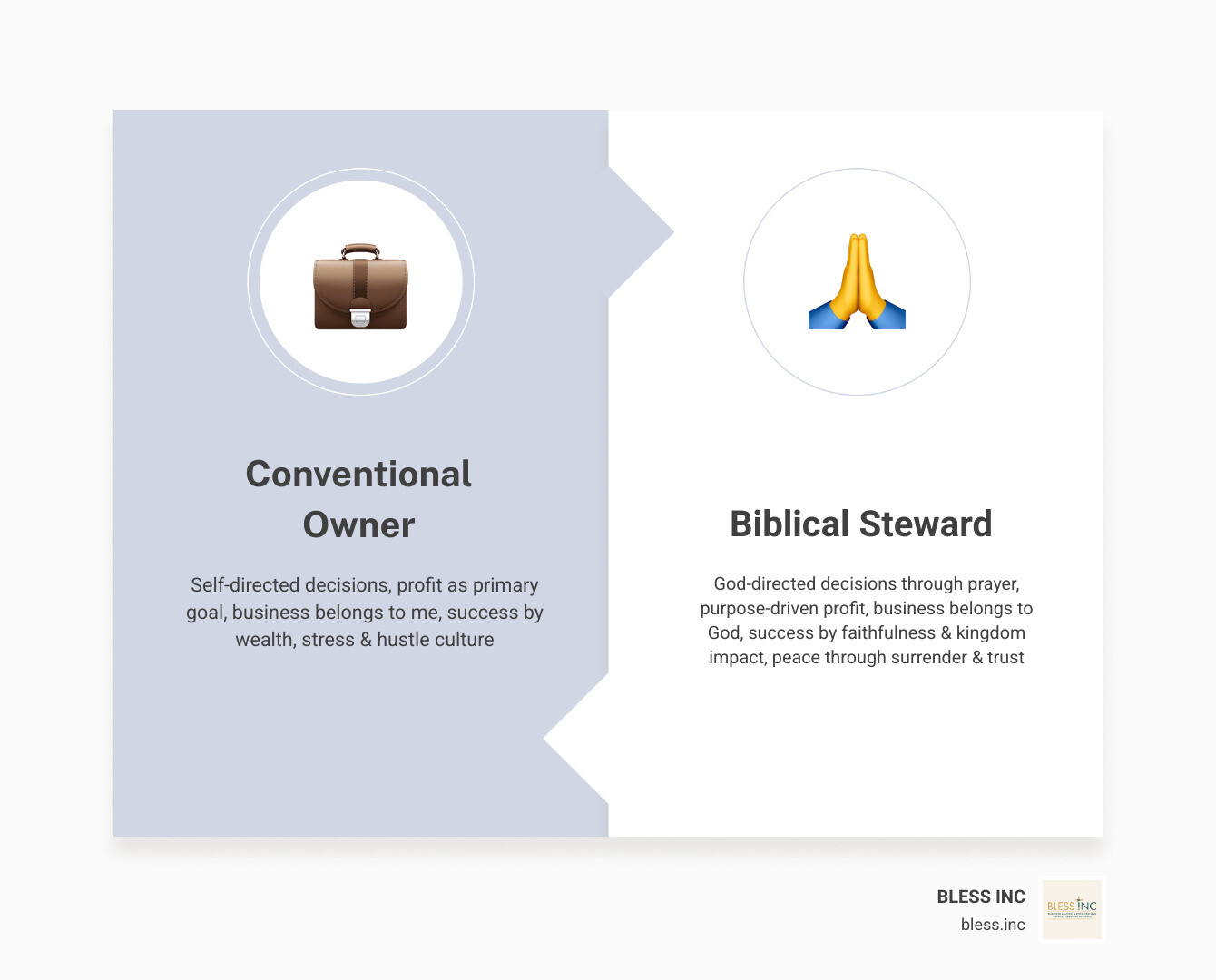
Defining Biblical Business Full Ownership: Stewardship vs. Absolute Rights

To understand biblical business full ownership, we have to look at the tension between legal reality and spiritual truth. Legally, your name might be on the articles of incorporation. You might hold 100% of the shares. But spiritually, Psalm 24:1 reminds us that “The earth is the Lord’s, and everything in it, the world, and all who live in it.”
Conventional ownership says: “I built this. I take the risks. I reap the rewards. I make the rules.”
Biblical stewardship says: “God entrusted this to me. I manage the risks through His wisdom. I use the rewards for His kingdom. I follow His rules.”
When you embrace this mindset, you move from being a “proprietor” to an “overseer.” An overseer doesn’t own the property, but they are responsible for its flourishing. This shift is what allows you to run a 7-figure business without the crushing weight of “carrying” the company on your own shoulders.
By maintaining 100% legal ownership — avoiding the trap of selling equity to investors who may not share your faith — you protect your ability to live out your faith in every boardroom decision. You aren’t answerable to a secular board looking only at quarterly returns; you are answerable to the Creator who looks at the heart.
Why Biblical Business Full Ownership Requires a “God as CEO” Mindset
If God owns the business, it only makes sense that He should be the CEO. Proverbs 16:3 tells us, “Commit to the Lord whatever you do, and he will establish your plans.”
Making God your CEO isn’t just a nice sentiment for a wall plaque; it’s a strategic operational choice. It means prayerful consulting before every major launch, hire, or pivot. Think about it: if you had a human CEO with infinite wisdom and a 100% success rate, wouldn’t you check with them before signing a contract?
When we surrender the “lead” role to Him, we find a peace in your business that the world cannot replicate. You stop “throwing spaghetti at the wall” and start moving with divine intentionality. Strategic planning becomes an act of listening, and decision-making becomes an act of obedience.
Integrating Integrity into Biblical Business Full Ownership
A business built on God’s principles must be built on the bedrock of integrity. Proverbs 11:1 is very clear: “The Lord detests dishonest scales, but accurate weights find favor with him.”
In the modern marketplace, “dishonest scales” look like:
- Hidden fees in your contracts
- Exaggerated marketing claims
- Underpaying employees while the owner takes massive bonuses
- Cutting corners on product quality to save a buck
When you operate with biblical business full ownership, you realize that honesty in business is a form of worship. It means transparent pricing and fair compensation. We treat our suppliers, team members, and even competitors with the same dignity we want for ourselves. Why? Because we aren’t just trying to win a transaction; we are representing the True Owner.
Core Principles for Running a God-Centered Enterprise
The world tells us that the only way to succeed is to “hustle” — to grind 80 hours a week, sacrifice our families, and out-shout the competition. But the Bible offers a different path: diligent work paired with radical trust.
| Worldly Hustle | Biblical Diligence |
|---|---|
| Driven by fear of lack | Driven by love for God |
| Success = Net Worth | Success = Faithfulness |
| Work is an identity | Work is an act of worship |
| Sacrifices rest for profit | Prioritizes Sabbath as trust |
| “I am the source” | “God is the provider” |
Colossians 3:23 reminds us, “Whatever you do, work at it with all your heart, as working for the Lord, not for human masters.” This leads to a “second-mile mentality” (Matthew 5:41) — doing more than is expected because you aren’t just serving a client; you are serving Christ.
However, this diligence must be balanced with rest. Practicing a Sabbath is the ultimate test of whether you believe you own the business or God does. If you can’t stop working for 24 hours, you might be addicted to the “hustle” or afraid that the business will fail without you. True stewardship involves overcoming overwhelm by surrendering your to-do list to the one who created time itself.
Finally, we must surround ourselves with wise counsel. Proverbs 13:20 says, “Walk with the wise and become wise, for a companion of fools suffers harm.” Whether it’s a mentor, a godly board of advisors, or a community of faith-driven peers, you need people who will hold you to biblical standards when the pressure to compromise rises.
Financial Stewardship and the Pursuit of Godly Profit
Is it “wrong” for a Christian business to make a profit? Absolutely not. In fact, profit is a measure of the value you’ve created for others. However, in biblical business full ownership, profit is a tool, not a god.
One practical way many kingdom entrepreneurs manage their resources is the 10/10/80 rule:
- 10% Tithe: Giving back to the local church or kingdom work first.
- 10% Savings/Investment: Preparing for the future and building a “storehouse” for lean times.
- 80% Operations and Living: Managing the rest with wisdom and excellence.
Proverbs 13:11 tells us that “wealth from get-rich-quick schemes quickly disappears; wealth grows over time through hard work.” We don’t chase shortcuts; we build for the “fourth generation.”
As a business owner, you should also consider your public benefits. Does your business model bless the community? Does it provide fair wages that allow your employees’ families to thrive? Mark 8:36 poses the ultimate question for every CEO: “What good is it for someone to gain the whole world, yet forfeit their soul?”
Kingdom ROI (Return on Investment) isn’t just measured in dollars; it’s measured in lives changed, families supported, and the Gospel advanced. When you retain 100% ownership, you have the unencumbered power to be radically generous with your profits, supporting missions and local needs without needing permission from secular shareholders.
Frequently Asked Questions about Biblical Business Ownership
Is it unbiblical to have business partners or investors?
The Bible doesn’t forbid partnerships, but it gives strong warnings about being “equally yoked” (2 Corinthians 6:14). If you take on a partner or an investor who does not share your biblical values, you will eventually face a “values collision.”
When an investor puts money into your company in exchange for equity, they often gain a say in how the business is run. If their primary goal is maximizing profit at any cost, and your goal is kingdom impact, you will find yourself in a difficult position. This is why we advocate for retaining biblical business full ownership whenever possible. Stewardship is much easier when you don’t have to compromise with “the world’s way” to please a financial backer.
How do I balance ambition with humility?
Ambition is not a sin; in fact, God gave us the “cultural mandate” in Genesis to subdue the earth and develop its resources. However, there is a difference between selfish ambition and godly ambition.
Philippians 2:3 tells us, “Do nothing out of selfish ambition or vain conceit. Rather, in humility value others above yourselves.” Godly ambition seeks to grow the business so that more people can be served and more resources can be funneled into the Kingdom. Humility recognizes that any success you achieve is a gift from God. You can be the most “successful” person in your industry and still walk in total humility if you remember that you are simply a steward of His grace.
What does it mean to “work for the Lord” in a secular market?
You don’t have to sell Bibles or Christian T-shirts to have a “ministry.” Whether you run a landscaping company, a tech startup, or a retail shop, your business is your platform.
Working for the Lord (Colossians 3:24) means:
- Quality Work: Your products should be the best in the market because they represent the King.
- Salt and Light: Your interactions with difficult clients or competitors should reflect Christ’s character.
- Marketplace Ministry: You have access to people (employees, vendors, customers) that a pastor might never meet. Your business is the “front line” of the Gospel.
Conclusion: Building a Legacy That Outlasts the Marketplace
At the end of the day, biblical business full ownership is about legacy. Not the kind of legacy that puts your name on a building, but the kind that hears “Well done, good and faithful servant” from the True Owner.
Running a business is hard. Scaling a business while keeping your faith at the center is even harder. You don’t have to do it alone. At BLESS INC, we understand the unique challenges of the faith-driven entrepreneur. We provide the operational support you need — from finance and HR to tech and admin — through our zero-equity accelerator.
Our mission is to help you thrive without asking for a piece of your company. We believe in your calling, and we want to see you retain 100% ownership so you can lead exactly as God directs you. With our tiered, sliding-scale pricing, we make professional-grade support accessible to founders at every stage.
Are you ready to stop “owning” and start stewarding? Are you ready to see what happens when you truly make God the CEO?
Discover our services and let’s build something with eternal impact together.
How to Find a Faith Driven Acceleration Program That Actually Works
Why a Faith Driven Acceleration Program Could Be the Missing Piece for Your Business
A faith driven acceleration program is a structured business accelerator that combines practical startup training with spiritual development, helping founders build companies without burning out or losing sight of their values.
Key features of faith-driven accelerators:
- Mentorship-driven – Focused on redemptive strategy and leadership
- Seed funding – Providing initial capital to help companies scale
- Global reach – Supporting businesses in emerging markets
- Theological integration – Where theology meets startup methodology
- Investor connections – Connecting value-aligned founders with capital
Here’s a hard truth: about 90% of startups fail. Most don’t fail because the founder lacked passion. According to industry research, they fail because of cash flow problems, weak teams, and misread markets.
But there’s another failure nobody talks about enough: the founder themselves burning out.
Scaling a business alone, while managing finances, HR, admin, and marketing, is exhausting. For faith-driven entrepreneurs, the pressure to grow without compromising values makes it even harder.
That’s exactly the gap faith-driven accelerators are designed to fill. They don’t just teach you how to pitch investors or build a product. They help you grow as a whole person, not just a business owner.
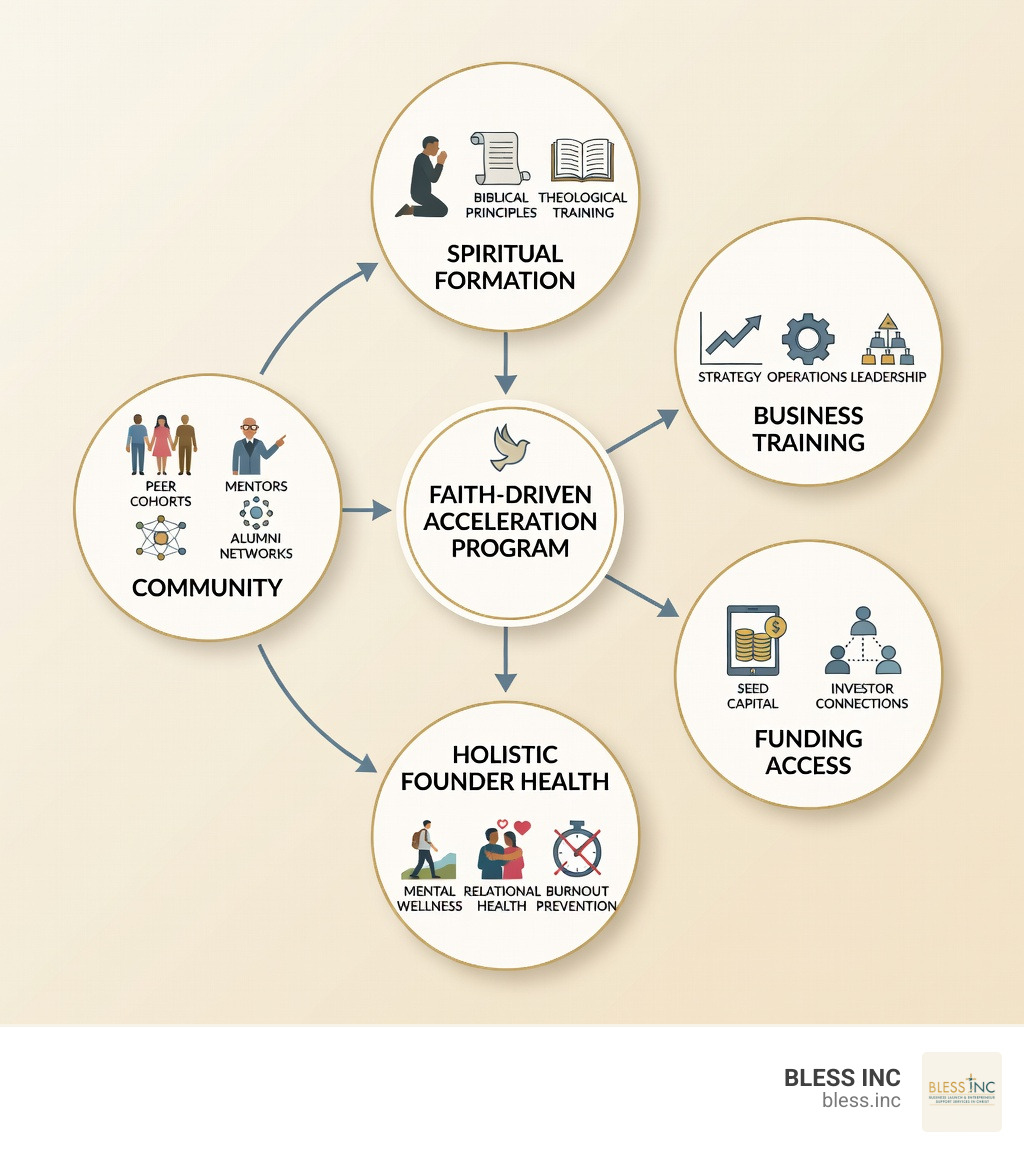
What Defines a High-Impact Faith Driven Acceleration Program?

When we look at the landscape of business growth, most programs focus exclusively on the “what” and the “how”—the product and the profit. A high-impact faith driven acceleration program flips the script by focusing on the “who” and the “why.”
At its core, redemptive entrepreneurship is about more than just making money; it’s about participating in God’s work of renewal. These programs prioritize spiritual formation alongside business excellence. They recognize that a founder’s identity shouldn’t be rooted in their valuation, but in their faith.
The primary purpose of these programs is to provide entrepreneurs with the tools, disciplines, and skills necessary to start and scale a company without sacrificing their relationships, health, and wellness. It’s a holistic approach to marketplace ministry that ensures your business grows in a way that is ethically sound and spiritually vibrant.
Core Components of a Faith Driven Acceleration Program
What should you expect when you sign up? While every program has its own “secret sauce,” most include these essential elements:
- Mentorship: Access to seasoned business leaders who have “been there, done that” and share your values.
- Seed Funding: Many programs provide initial capital (often around $35,000) to help you get off the ground.
- Theological Training: Understanding how your work connects to God’s mission in the world.
- Peer Community: A cohort of fellow founders who understand the unique loneliness of leadership.
- Strategic Advice and Market Publicity: Helping you refine your model and get it in front of the right people.
- Zero Equity Models: Some programs (like ours at BLESS INC) allow you to keep 100% ownership of your vision while receiving the support you need.
Integrating Spiritual Growth with Business Metrics
How do you measure “spiritual growth” alongside “monthly recurring revenue”? It starts by applying biblical principles to everyday business operations.
This involves establishing daily disciplines—like rhythms of rest and reflection—that prevent the typical startup “grind” from destroying your soul. Prayer-centered leadership becomes a practical tool for decision-making, not just a Sunday morning activity. When you scale your culture through this lens, you aren’t just hiring employees; you’re practicing stewardship and servant leadership. You are living out your faith in the marketplace, treating every customer interaction and vendor contract as an opportunity for Kingdom impact.
How Faith-Based Accelerators Differ from Traditional Startup Models
Traditional accelerators are often high-pressure environments where the primary goal is a massive exit. While there’s nothing wrong with profit, the traditional model can sometimes lead to avoidable mistakes. Statistics show that 82% of startups fail due to cash flow problems, and 42% fail because they misread market demand.
Faith-based accelerators address these risks by surrounding the founder with a supportive community rather than a cutthroat competition.
Traditional vs. Faith-Driven Accelerators
| Feature | Traditional Accelerator | Faith-Driven Accelerator |
|---|---|---|
| Primary Goal | Rapid scale and high-value exit | Redemptive impact and stewardship |
| Equity | Usually takes 5-10% equity | Often zero-equity or mission-aligned |
| Focus | Product-market fit and VC readiness | Holistic founder health and purpose |
| Culture | “Move fast and break things” | “Move with purpose and heal things” |
| Community | Competitive networking | Collaborative peer support |
| Failure Rate | High (90% of tech startups) | Focused on sustainability and resilience |
Evaluating Funding and Resource Accessibility
Funding is often the biggest hurdle. Research shows that 29% of startups fail because they simply ran out of money. A faith driven acceleration program helps bridge this gap by preparing you for “investor readiness.”
Programs provide seed financing, but more importantly, they connect you with faith-aligned investors—people who care about your mission as much as your margins. These investors are often part of networks looking for “deal flow” that matches their values. By participating in an accelerator, you gain access to capital, talent acquisition resources, and the strategic advice needed to make that initial investment last.
Geographic and Sectoral Focus Areas
While tech is a major focus, faith-driven programs are incredibly diverse.
- High-Tech Startups: Many programs focus heavily on venture-backable, tech-enabled companies.
- Social Impact: Many programs focus on solving pressing social challenges, particularly in emerging markets.
- Regional Focus: Various initiatives have a massive impact on the African continent, where small and growing businesses (SGBs) fuel 67-80% of new job growth.
- Creative Spaces: Some initiatives even transform physical buildings into creative workspaces with resident support to help the community.
Key Criteria for Choosing a Faith Driven Acceleration Program
Not every program is the right fit for every founder. Here is how to narrow down your options:
- Acceptance Rates and Selectivity: Some programs are highly competitive, accepting only a small number of startups per cohort to ensure high-quality mentorship.
- Program Duration: Most programs run between 12 and 17 weeks. You need to decide if you can commit the time. Some virtual programs require about 6 hours per week, while others might be more intensive.
- Participation Model: Are you looking for a hybrid model? Many programs offer remote participation with a few onsite intensives. This is perfect for founders who can’t relocate but want the benefit of in-person connection.
- Stage of Business: Are you at the “ideation” stage or the “founder-to-CEO transition” stage? Some programs are great for early plans, while others focus on scaling businesses with 25+ employees.
Assessing Holistic Well-being and Support
A major differentiator for a faith driven acceleration program is its commitment to your mental and spiritual health. They often provide access to:
- Certified Guides and Coaches: To help you navigate the emotional highs and lows of entrepreneurship.
- Workplace Chaplaincy: Organizations like Marketplace Chaplains provide care for you and your future team.
- Resilience Training: Building the “spiritual grit” needed to survive the 18-month window where most high-tech startups fail.
Success Stories and Alumni Outcomes
The numbers speak for themselves. Alumni from leading faith-driven accelerators have collectively raised more than $100 million from international funds and angels. The average seed round for these alumni is approximately $1 million.
Beyond the money, the impact on the community is profound. Since SGBs (businesses with 5 to 250 employees) account for the vast majority of new job growth, these accelerators aren’t just building companies—they are transforming societies. Whether it’s equipping indigenous entrepreneurs in marginalized communities or helping a solo founder reach the stage of a major venture acceptance, the outcomes are sustainable and redemptive.
Frequently Asked Questions about Faith-Driven Accelerators
Do I have to be a Christian to join a faith driven acceleration program?
While these programs are Christ-centered and draw heavily from biblical wisdom, many are inclusive. For example, many accelerators do not require you to be a Christian to participate, but you must be willing to engage in faith discussions and explore how these principles apply to your business. The goal is often spiritual exploration and values alignment rather than a strict “members only” policy.
What is the typical time commitment for these programs?
It varies, but a common standard is about 6 hours of work per week for virtual programs. More intensive accelerators may require 12-17 weeks of dedicated focus, including weekly virtual sessions, 1:1 mentoring, and peer collaboration. Most also feature a kickoff retreat or a “Demo Day” finale.
How do these programs connect founders with investors?
They act as a curated “deal flow” source. Through pitch competitions, investor newsletters, and networking events, they put you in front of redemptive funders. These investors are specifically looking for businesses that share their values, making the fundraising process much more focused and less like a “cold call.”
Conclusion: Taking the Next Step in Your Entrepreneurial Journey
Finding a faith driven acceleration program that actually works means looking for a partner that values your soul as much as your spreadsheet. You don’t have to choose between business excellence and your spiritual health.
At BLESS INC, we understand the unique challenges of the faith-driven founder. We provide the operational support you need—handling the heavy lifting of finance, HR, tech, and admin—so you can focus on your God-given vision. Our zero-equity accelerator model ensures that you retain 100% ownership of your company while benefiting from Christ-centered compassion and professional excellence.
We offer tiered, sliding-scale pricing to make our services accessible to entrepreneurs at various stages. If you’re ready to scale your business without losing your way, we’re here to help.