

Keep Calm and Follow NIST Incident Management
Why NIST Incident Management Is Your First Line of Defense
NIST incident management is a structured, four-phase process for handling cybersecurity threats — from the moment you prepare, all the way through lessons learned after an attack.
Here’s the quick version:
- Preparation – Build your plan, team, and tools before anything goes wrong
- Detection and Analysis – Spot the threat and understand its scope
- Containment, Eradication, and Recovery – Stop the damage, remove the threat, restore operations
- Post-Incident Activity – Review what happened and improve for next time
This process is defined in NIST Special Publication 800-61, now in its third revision (April 2025), and it maps directly to the NIST Cybersecurity Framework (CSF) 2.0.
Cyberattacks don’t take days off. And as a faith-driven entrepreneur wearing every hat in your organization, a security incident can feel like the worst possible interruption — one you’re completely unprepared for.
Here’s the hard truth: most organizations that suffer serious damage from a breach weren’t caught off guard by a sophisticated attacker. They were caught without a plan.
NIST has spent decades building a framework that any organization — large or small — can follow to respond to incidents calmly, consistently, and effectively. The good news? You don’t need a massive IT department to follow it. You need clarity, structure, and the right process.
This guide walks you through exactly that.
Understanding the NIST Incident Management Framework
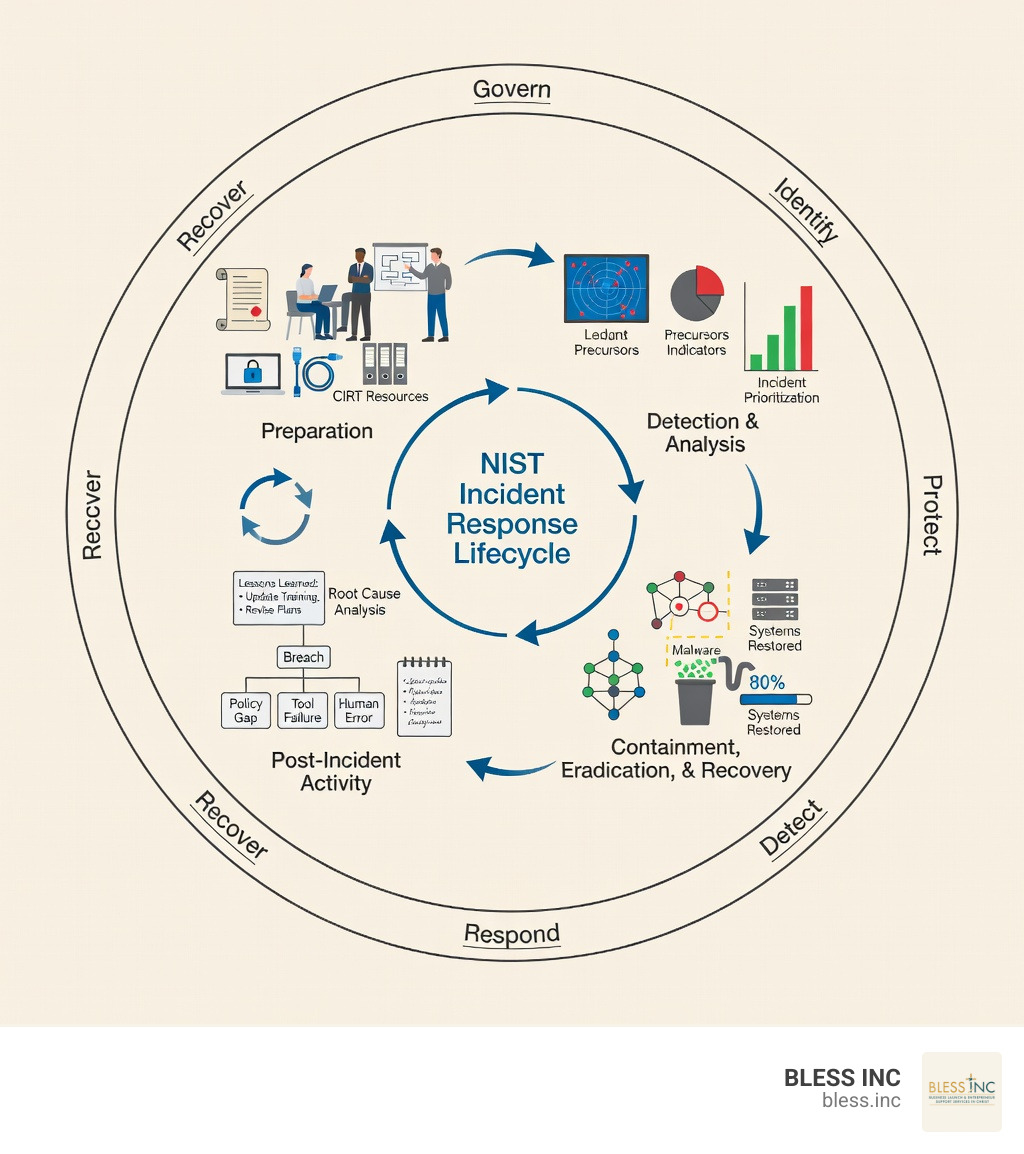
When we talk about nist incident management, we are referring to a set of gold-standard guidelines developed by the National Institute of Standards and Technology. Specifically, the NIST SP 800-61 Revision 3 is the foundational blueprint. Released in April 2025, this version represents a significant shift from older versions, moving away from a simple “how-to” guide and toward a strategic integration with broader cybersecurity risk management.
At its core, this framework helps us answer the “Who, What, When, and How” of a breach. It isn’t just about technical fixes; it’s about governance. By using Managed Risk Support, organizations can align their incident response with the Govern function of the NIST Cybersecurity Framework (CSF) 2.0. This ensures that leadership is involved, policies are clear, and the “Identify” and “Protect” functions are working in harmony to prevent incidents before they start.
Integrating NIST SP 800-61 with CSF 2.0
The magic of the newest NIST revision is how it snaps into the CSF 2.0. Think of the CSF 2.0 as the “big picture” strategy, while SP 800-61 provides the tactical “boots on the ground” maneuvers.
The framework alignment focuses on six key functions: Govern, Identify, Protect, Detect, Respond, and Recover. While incident response traditionally lived in the “Respond” category, NIST now emphasizes that effective management requires a risk-based approach across the entire lifecycle. By integrating these, we don’t just react to a virus; we strategically manage the risk that the virus poses to our specific mission and values.
Core Objectives of NIST Incident Handling
Why do we go through all this trouble? We have four primary goals:
- Damage Containment: Stop the bleeding. We want to prevent a small infected laptop from becoming a company-wide ransomware disaster.
- Service Restoration: Get back to work. Our goal is to restore computing services as efficiently as possible to minimize business disruption.
- Evidence Preservation: If we need to involve law enforcement or insurance, we need a clean digital paper trail.
- Vulnerability Mitigation: We don’t just want to fix the problem; we want to make sure it never happens again by patching the hole the attacker used.
The Four Phases of the NIST Incident Response Lifecycle
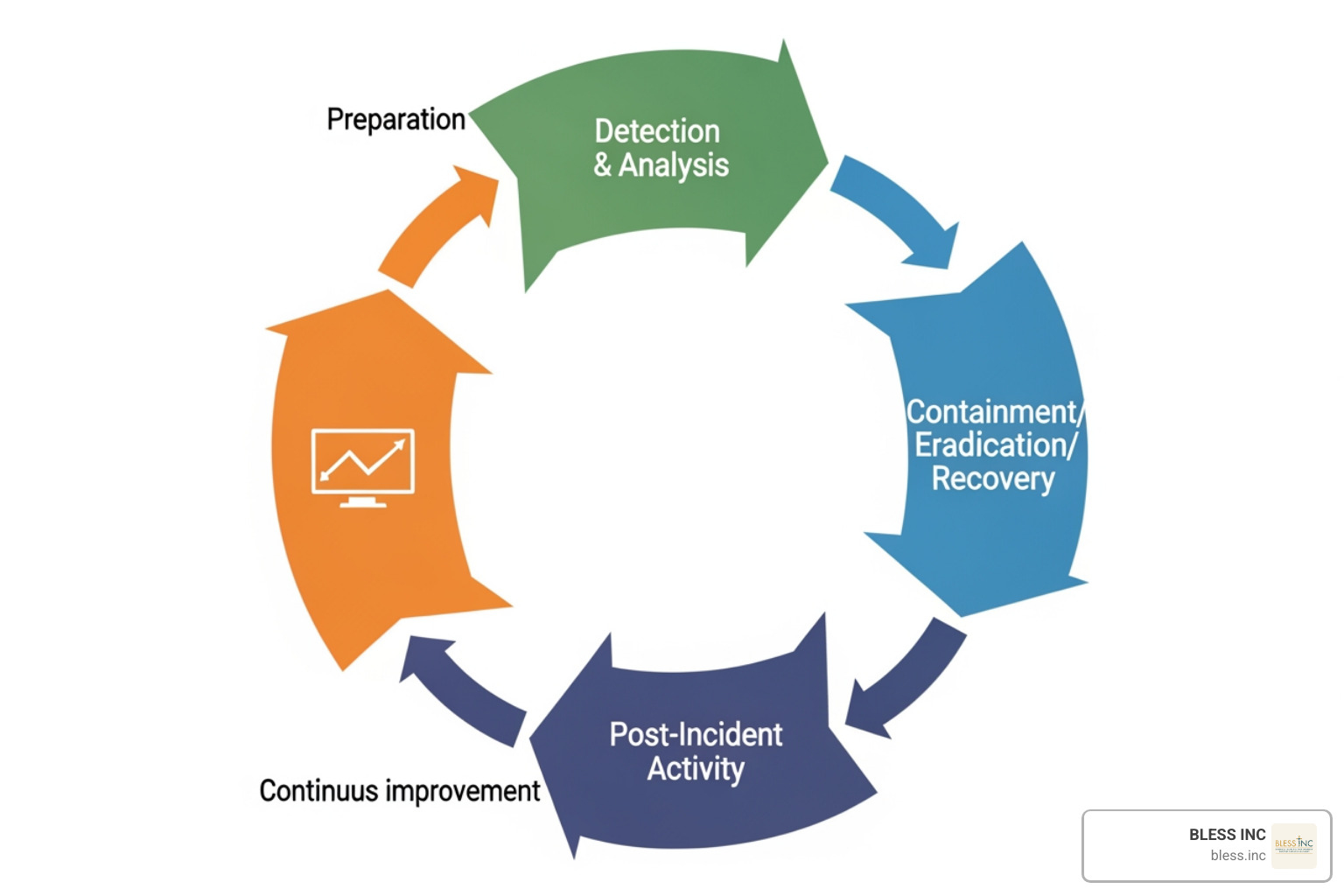
The NIST lifecycle is a circle, not a straight line. Every time we finish responding to an incident, the “lessons learned” feed right back into our preparation for the next one. If you find yourself in the middle of a crisis right now, your first step should be an Emergency Support Request to get expert eyes on the problem immediately.
Phase 1: Preparation and Readiness
Preparation is the most critical phase because it happens when things are calm. If you wait until the screen turns red to think about your plan, you’ve already lost.
First, you need an asset inventory. You can’t protect what you don’t know you have. Second, you need a written plan. We recommend starting with a proven Incident Response Plan Template to define roles and responsibilities.
Finally, gather your “jump kit.” This is a portable set of tools—software, extra hard drives, cables, and even printed contact lists—that your team can grab the second an incident is declared. You should also establish a “baseline” of normal activity so you can actually tell when something looks “weird” on your network.
Phase 2: Detection and Analysis
How do we know we’re under attack? NIST distinguishes between precursors and indicators.
- Precursors are signs that an incident might happen (like a web server log showing a vulnerability scanner).
- Indicators are signs that an incident is happening (like an antivirus alert or a user reporting they can’t open their files).
In this phase, we use SIEM (Security Information and Event Management) alerts and analyze attack vectors to prioritize the incident. Not every alert is a five-alarm fire. We prioritize based on functional impact (is the whole office down?) and information impact (was sensitive data stolen?).
Phase 3: Containment, Eradication, and Recovery
Once we’ve confirmed the threat, we move to stop it.
- Short-term containment: This might mean pulling the network cable on an infected server or blocking a specific IP address at the firewall.
- Eradication: We find every trace of the attacker. This includes deleting malware, disabling breached user accounts, and patching the original vulnerability.
- Recovery: We restore systems from clean backups. We don’t just turn things back on; we monitor them closely to ensure the attacker doesn’t have a “backdoor” to get back in.
Throughout this phase, we must maintain forensic integrity. If we just wipe a drive without taking an image first, we lose the evidence needed to understand what the attacker did.
Phase 4: Post-Incident Activity and Lessons Learned
This is the phase most people skip, yet it’s where the most growth happens. Within two weeks of a major incident, we hold a “lessons learned” meeting. We ask: What happened? How well did the team respond? What information did we need sooner?
We document everything. If you need a framework for this documentation, the California Government IR Plan Template offers a detailed 17-step procedure that includes excellent post-incident reporting structures. This root cause analysis is what turns a bad day into a stronger future.
Structuring Your Incident Response Team (CIRT)
You need a Computer Incident Response Team (CIRT), but it doesn’t have to be ten full-time security geniuses. NIST provides different models based on your needs.
| Model | Description | Best For |
|---|---|---|
| Centralized | A single team handles incidents for the whole organization. | Small to medium businesses with one main location. |
| Distributed | Multiple teams handle specific branches or departments. | Large, geographically dispersed corporations. |
| Coordinated | A central team provides guidance, but local teams do the work. | Organizations with highly specialized departments. |
When deciding on a staffing model, you have to choose between full-time vs. part-time and outsourced vs. in-house. Many smaller organizations find that a hybrid approach—having an internal point of contact supported by Managed Cybersecurity experts—provides the best 24/7 availability without the massive overhead.
Selecting the Right CIRT Model for Your Organization
Choosing a model depends on your organizational size, risk profile, and budget. If you are a faith-driven entrepreneur with a small team, a “virtual” CIRT made of part-time employees and an external partner is usually the most sustainable path. The key is that the team is formalized. Everyone needs to know exactly what their job is when the “Go” signal is given.
Essential Skills for NIST Incident Management
A good incident responder needs more than just technical proficiency. They need:
- Communication Skills: To explain technical disasters to non-technical leaders.
- Legal Knowledge: To understand when a breach requires a HIPAA notification.
- Stress Management: Because incident response is high-pressure work.
- Forensic Capabilities: To preserve evidence without corrupting it.
Why NIST Compliance is Vital for Modern Organizations
Adopting nist incident management isn’t just about being “tech-savvy”—it’s often a legal requirement. If you handle health data, HIPAA regulatory requirements mandate robust incident response. If you take credit cards, PCI-DSS payment security standards apply. And for those of us working as CMMC for defense contractors, having a NIST-aligned plan is non-negotiable.
Strengthening Resilience through NIST Incident Management
Beyond compliance, the framework builds cybersecurity resilience. It shifts your organization from a “hope for the best” mindset to a “prepared for the worst” posture. This proactive defense reduces downtime, protects your reputation, and builds stakeholder trust. When supply chain security is under constant scrutiny, being able to prove you follow NIST standards makes you a more attractive partner.
Supporting Global Compliance Standards
The beauty of NIST is that it plays well with others. If you align with NIST, you are already well on your way to meeting ISO 27001 standards, FISMA mandates, and even GDPR readiness. The framework ensures you have the audit trails and documentation necessary to prove you acted with “due diligence” during a crisis.
Best Practices for Implementing NIST Incident Management
Implementing this doesn’t happen overnight. We recommend a step-by-step approach:
- Policy Development: Get leadership to sign off on a formal Incident Response Policy.
- Team Formation: Identify your CIRT members and their backups.
- Tool Deployment: Invest in automated tools like EDR (Endpoint Detection and Response) or SOAR (Security Orchestration, Automation, and Response).
- Regular Testing: Conduct tabletop exercises. Sit your team down and say, “Okay, the CEO’s email was just hacked. What’s step one?”
If budget is a concern, consider a Cybersecurity Grant Application to help fund the initial setup of your program.
The Role of Information Sharing and Post-Incident Analysis
You don’t have to fight alone. NIST encourages information sharing through ISACs (Information Sharing and Analysis Centers) and reporting to organizations like US-CERT. By sharing threat intelligence (anonymously, of course), we help the entire community stay ahead of new attack patterns. This feedback loop is what makes the global cybersecurity ecosystem stronger.
Frequently Asked Questions about NIST Incident Management
Why is the preparation phase considered the most critical?
Preparation is the foundation. It’s the only phase where you have the luxury of time. By building your plans, training your team, and deploying your tools ahead of time, you ensure that when an incident does happen, your response is fast, clinical, and effective. Speed is the enemy of the attacker.
How often should an Incident Response Plan be updated?
At a minimum, you should review your plan annually. However, you should also update it immediately after any major incident (to include lessons learned) or whenever there are significant changes to your technology stack or the threat landscape.
What is the difference between NIST SP 800-61 Revision 2 and Revision 3?
Revision 2 (from 2012) was more of a technical “how-to” guide. Revision 3 (2025) is a full rewrite that aligns specifically with CSF 2.0. It focuses more on strategic risk management, governance, and the continuous improvement lifecycle rather than just technical checklists.
Conclusion
At BLESS INC, we believe that faith-driven entrepreneurs shouldn’t have to sacrifice their peace of mind to build a successful business. Our mission is to provide the operational support you need—from finance to tech—so you can focus on your calling.
Through our zero-equity accelerator, we offer Managed Cybersecurity Services that help you implement these complex NIST standards without the stress of doing it alone. You retain 100% ownership of your vision, and we provide the “Christ-centered compassion” and technical expertise to keep it safe.
Don’t wait for a crisis to find out if your defenses hold. Start your NIST journey today, and remember: keep calm, follow the framework, and let us help you carry the load.