Scaling Up on a Sliding Scale: Why Your Budget Shouldn’t Stop Your Big Idea
Why Your Budget Shouldn’t Disqualify You from Business Acceleration
A sliding scale business accelerator is a program that adjusts its fees, equity requirements, or investment terms based on a startup’s ability to pay — so founders at different financial starting points can access the same quality of support.
Here’s what that means in practice:
- Low-revenue founders pay less (or give up less equity) to participate
- Higher-revenue founders pay more, helping offset costs for others
- Everyone gets access to mentorship, networks, and structured growth support
- No single fixed price locks out founders who are capital-constrained
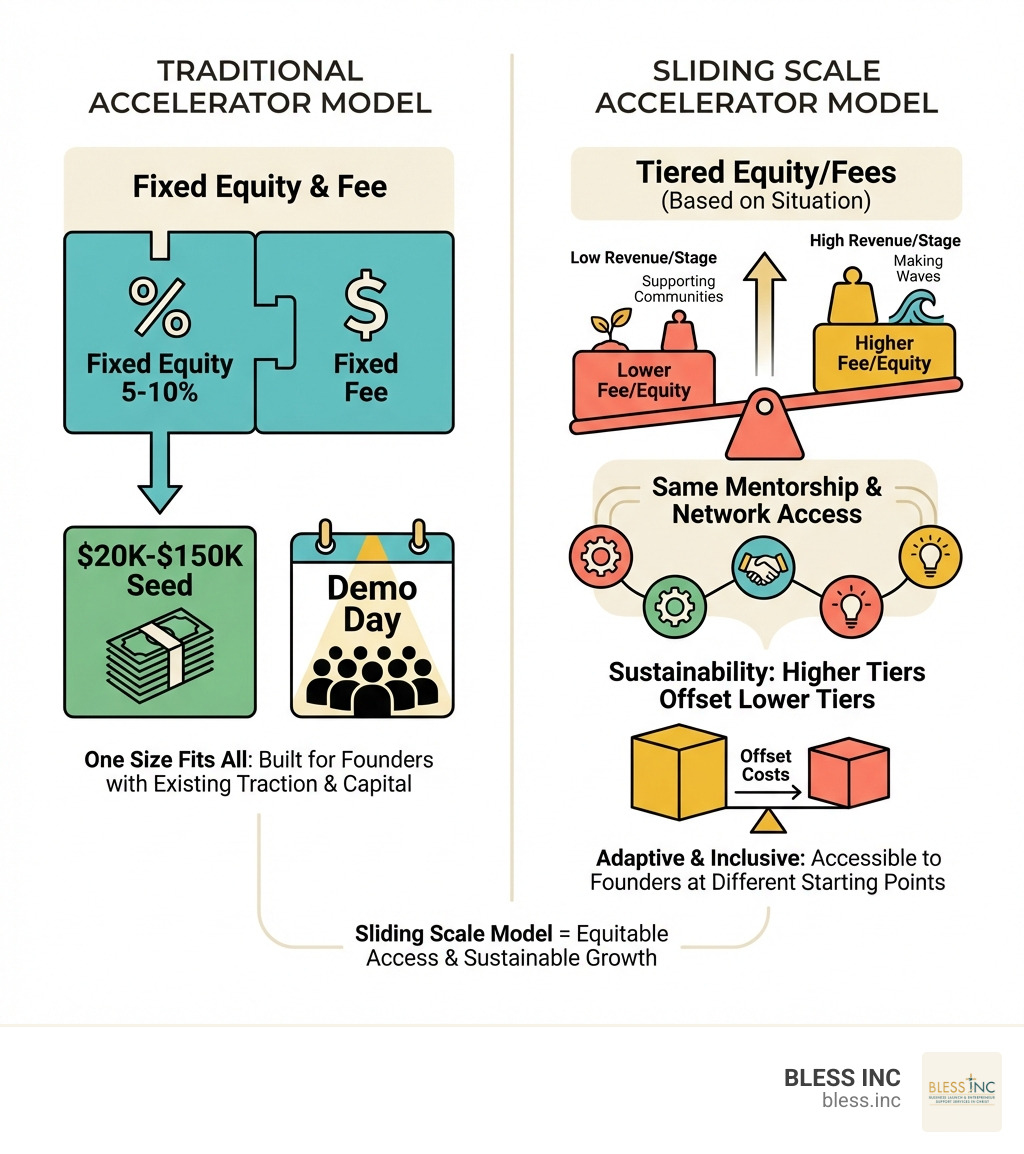
Most business accelerators follow a familiar playbook: take 5–10% equity, offer $20,000–$150,000 in seed funding, run a 3–6 month cohort, and close with a demo day. It’s a proven model — but it’s built for founders who already have traction, connections, and capital runway.
That leaves a huge group behind.
If you’re a faith-driven entrepreneur managing finance, HR, tech, and admin on your own — with limited cash flow and a big vision — the traditional accelerator model can feel like a door that’s just slightly out of reach. You need the mentorship and structure an accelerator provides, but the price of entry is the problem.
That’s exactly where the sliding scale model changes the equation.
Instead of one fixed barrier, it creates a range. Founders self-select into a tier that reflects their real financial situation — not just their annual revenue, but factors like debt, dependents, business stage, and even systemic disadvantages they’ve faced. As one entrepreneurship program puts it: “You are the best judge of your ability to pay, no questions asked.”
The result? Accelerator access becomes less about how much money you already have, and more about how far you’re willing to go.
Understanding the Sliding Scale Business Accelerator Model

To understand how a sliding scale business accelerator works, we first need to look at what it’s accelerating. A business accelerator is a fixed-term, cohort-based program that includes mentorship and educational components. Most culminate in a public pitch event or “demo day.”
Traditional models are often rigid. They ask for a specific percentage of your company in exchange for a set amount of cash. But what if you don’t want to sell your “baby” just yet? Or what if you are building a Zero Equity Accelerator model where the goal is to keep 100% ownership?
This is where the sliding scale comes in. It is a variable pricing structure that adjusts charges based on a customer’s ability to pay or their current business stage. This means the cost of the program—whether paid in fees or structured via investment terms—is not a “one-size-fits-all” barrier.
Most accelerators require you to have at least a Minimum Viable Product (MVP). As Eric Ries famously defined it, an MVP is the version of a new product that allows a team to collect the maximum amount of validated learning with the least effort. Once you have that MVP, you’re ready to scale. The sliding scale ensures that your current bank balance doesn’t dictate whether you get the help needed to turn that MVP into a market leader.
How a sliding scale business accelerator structures fees and equity
In a sliding scale business accelerator, the financial “ask” is typically broken down into tiers. Unlike the fixed 7% equity taken by many top-tier US accelerators, a sliding scale might offer a range of options:
- Revenue-Based Tiers: If your startup is generating $0–$50k annually, your program fee might be subsidized. If you’re at $150k–$4M, you might pay a “Full Cost” or “Redistribution” rate.
- Equity Percentages: Some models might offer a “sliding equity” scale. A founder might choose to give up 2% equity for a smaller investment or 10% for a larger capital injection and more intensive support.
- Structured Funding Stages: We often see programs that use a three-stage funding process. They don’t give you everything at once; they validate your progress at each step, which is a form of “scaling” the support as the business grows.
| Feature | Fixed Equity Model | Sliding Scale Model |
|---|---|---|
| Equity Taken | Usually 5–10% (Fixed) | 0% to Variable % |
| Program Fees | Often free (but high equity cost) | Tiered based on ability to pay |
| Accessibility | High barrier (1-3% acceptance) | Inclusive of diverse financial backgrounds |
| Ownership | Diluted immediately | Often 100% retained (in zero-equity models) |
The impact of a sliding scale business accelerator on diversity and inclusion
Economic justice is at the heart of the sliding scale. We recognize that not every founder starts on a level playing field. Some have access to generational wealth, while others are supporting dependents or dealing with significant debt.
By using equitable pricing strategies, an accelerator can account for systemic privileges like race, gender, and class. Instead of a scholarship model—which can often feel like a “handout” or involve invasive applications—the sliding scale relies on trust and self-selection.
When we look at an Accelerator Tier Comparison, we see that this model allows underrepresented founders to enter the ecosystem without the “cliff” of high initial costs. It’s about dismantling cost barriers for those working in the “frontline” of their communities, ensuring that a lack of initial capital doesn’t mean a lack of future impact.
Why Startups Choose Flexible Acceleration Models
Why would a founder choose a sliding scale business accelerator over a big-name, fixed-equity program? For many of the faith-driven entrepreneurs we work with, the answer is simple: stewardship and mission.
When you’ve spent years bootstrapping your vision, giving away 7-10% of your company for a three-month program can feel like poor stewardship of the gift you’ve been given. Flexible models allow you to keep your hands on the wheel. You can find Accelerate Pricing that fits your current cash flow, rather than sacrificing your future cap table.
Benefits for early-stage ventures
For a startup in its infancy, every dollar counts. Choosing a sliding scale model provides:
- Mentorship Without “Taxation”: You get the same high-level advice from industry experts without the permanent equity “tax” on your business.
- Resource Allocation: Instead of a massive upfront fee, you can put your capital toward product development or hiring your first employee.
- Tailored Support: Programs focused on Accelerate Growth often provide modular support. You only pay for (and engage with) the resources you actually need at your current stage.
Comparing sliding scales to traditional fixed-fee programs
Traditional fixed-fee programs can be just as exclusionary as equity-heavy ones. If an accelerator charges a flat $10,000 fee, a founder with $1M in the bank barely notices, while a founder living paycheck-to-paycheck is locked out.
In contrast, our Accelerate Scale approach ensures that the “energetic exchange” is fair. The goal is to move away from “standardization” and toward “equity.” By offering tiers—from “Supporting Communities” for those making ends meet to “Lifting Up the World” for those with expendable income—we ensure that the program remains sustainable for us while staying affordable for you.
Criteria for Determining Your Position on the Scale
How do you know where you land on the scale? It isn’t just about what’s in your bank account today. It’s about a holistic view of your business and your life.
When we help founders navigate Accelerate Perform, we encourage them to look at several factors. It’s a self-guided process of reflection.
Revenue and growth metrics
The most obvious metric is your annual revenue. Many programs use specific thresholds:
- Formation/Startup Stage: Revenue under $50k or businesses still refining their MVP.
- Growth Stage: Revenue between $50k and $150k with established sales.
- Expansion Stage: Revenue over $150k with a full-time team.
We also look at cash flow and profitability. A company with $200k in revenue but $190k in expenses is in a very different position than a solo consultant with $100k in revenue and $10k in expenses. Programs like Utopian Accelerate take these nuances into account to ensure the pricing doesn’t break the business it’s trying to build.
Social impact and founder background
We believe your background matters. Are you coming from a marginalized community? Do you have intergenerational wealth, or are you the first in your family to start a business?
Programs like Odyssey prioritize mission alignment. If your business is designed to have a high community impact or solve a pressing social issue, your “value” to the accelerator isn’t just financial. In these cases, the sliding scale might lean toward the “Solidarity” or “Redistribution” rates, recognizing that your success will benefit many others.
Challenges and Sustainability of the Sliding Scale Model
We have to be honest: running a sliding scale business accelerator is more complex than a standard model. From a management perspective, it requires a high level of trust and administrative oversight.
According to Software Advice on sliding scale drawbacks, some of the risks include:
- Revenue Loss: If everyone self-selects into the lowest tier, the program can’t pay its mentors or keep the lights on.
- Abuse Potential: There is always a risk that someone who can afford the full price will choose the discounted rate.
- Standardization Challenges: It’s harder to predict annual budgets when your income per “customer” varies wildly.
Maintaining accelerator sustainability
To keep a program like Accelerator Original healthy, we rely on a “balanced ecosystem.” Sustainability requires a healthy blend of participants. Ideally, the “Making Waves” and “Lifting Up The World” tiers (the higher-paying participants) offset the costs for those in the “Supporting Communities” tier.
We also look for external partners—foundations, corporate sponsors, or donors—who believe in economic inclusivity. This helps bridge the funding gaps and covers the operational costs of providing high-quality finance, HR, and tech support.
Potential drawbacks for participating startups
Founders should also be aware of potential downsides:
- Perception Risks: Some investors might (wrongly) assume that a “discounted” seat in an accelerator means a “discounted” quality of startup.
- Resource Limitations: If an accelerator is struggling for sustainability, it may not be able to offer the same level of perks (like massive AWS credits or high-end office space) as a multi-billion dollar VC-backed program.
Frequently Asked Questions about Sliding Scale Accelerators
How does a sliding scale differ from a scholarship model?
A scholarship model often requires a “proof of poverty” or a lengthy application where you have to justify why you deserve help. It creates a “gatekeeper” dynamic. A sliding scale is built on self-selection. You are the best judge of your own financial reality. It’s about economic accuracy and removing the psychological barrier of “asking for a favor.”
Can I retain 100% ownership in these programs?
Yes! That is one of the biggest draws of our model. Many sliding scale programs are also zero-equity programs. Because you are paying a fee (even if it’s a scaled one), you are a client, not just a portfolio entry. This allows you to retain 100% ownership and control over your vision.
What documentation is needed to qualify for lower tiers?
While some programs are “no questions asked,” others may ask for basic eligibility guidelines to ensure fairness. This might include:
- Recent income statements or P&L reports.
- Tax documents from the previous year.
- A brief statement on your current debt-to-income ratio or number of dependents.
The goal isn’t to be a “financial police” but to ensure that the limited subsidized spots go to those who truly need them.
Conclusion
At BLESS INC, we believe that your calling shouldn’t be limited by your capital. Our heart is to provide the operational support—the “heavy lifting” of finance, HR, tech, and admin—that faith-driven entrepreneurs need to thrive.
By offering a sliding scale business accelerator model, we ensure that our services are accessible to those just starting their journey, while providing a way for more established leaders to “pay it forward.” We are Christ-centered and compassion-driven, but we are also results-oriented. We want to see you scale up without giving up the ownership of what God has called you to build.
If you’re ready to grow your big idea on a budget that makes sense for you, we invite you to Discover our services and join a community that values your mission as much as your metrics.
BLESS INC
Helping you scale with 100% ownership and 0% compromise.