Zero Equity Accelerator Program Guide for Founders Who Hate Dilution
Why Every Founder Should Know About Zero Equity Accelerator Programs
A zero equity accelerator program is a startup program that gives you mentorship, funding, and resources — without taking a single share of your company.
There are several well-known options available today that focus on different industries, from healthcare and biotech to SaaS and climate tech. These programs provide varying levels of funding, often ranging from $30,000 to over $500,000 in non-dilutive awards, while others focus on providing free resources and technical support for several months.
You keep 100% of your company. No dilution. No strings.
These programs exist because governments, corporations, and technical partners want to support innovation — without needing an ownership stake to benefit from it.
If you’re a founder already stretched thin across finance, HR, operations, and your actual product, giving away equity on top of all that can feel like losing a piece of what you worked so hard to build. Traditional accelerators often take 5–10% equity in exchange for their support. That adds up fast, especially when you’re just getting started.
The good news? Zero equity accelerator programs are growing globally — and they’re becoming more competitive, more funded, and more sector-specific than ever.
Top-tier zero equity programs have already helped hundreds of alumni raise hundreds of millions in funding, generate significant revenue, and create thousands of jobs — all without taking equity from a single participant.
This guide breaks down exactly how these programs work, what to look for, and how to find the right fit for where you are right now.
What Defines a Zero Equity Accelerator Program?
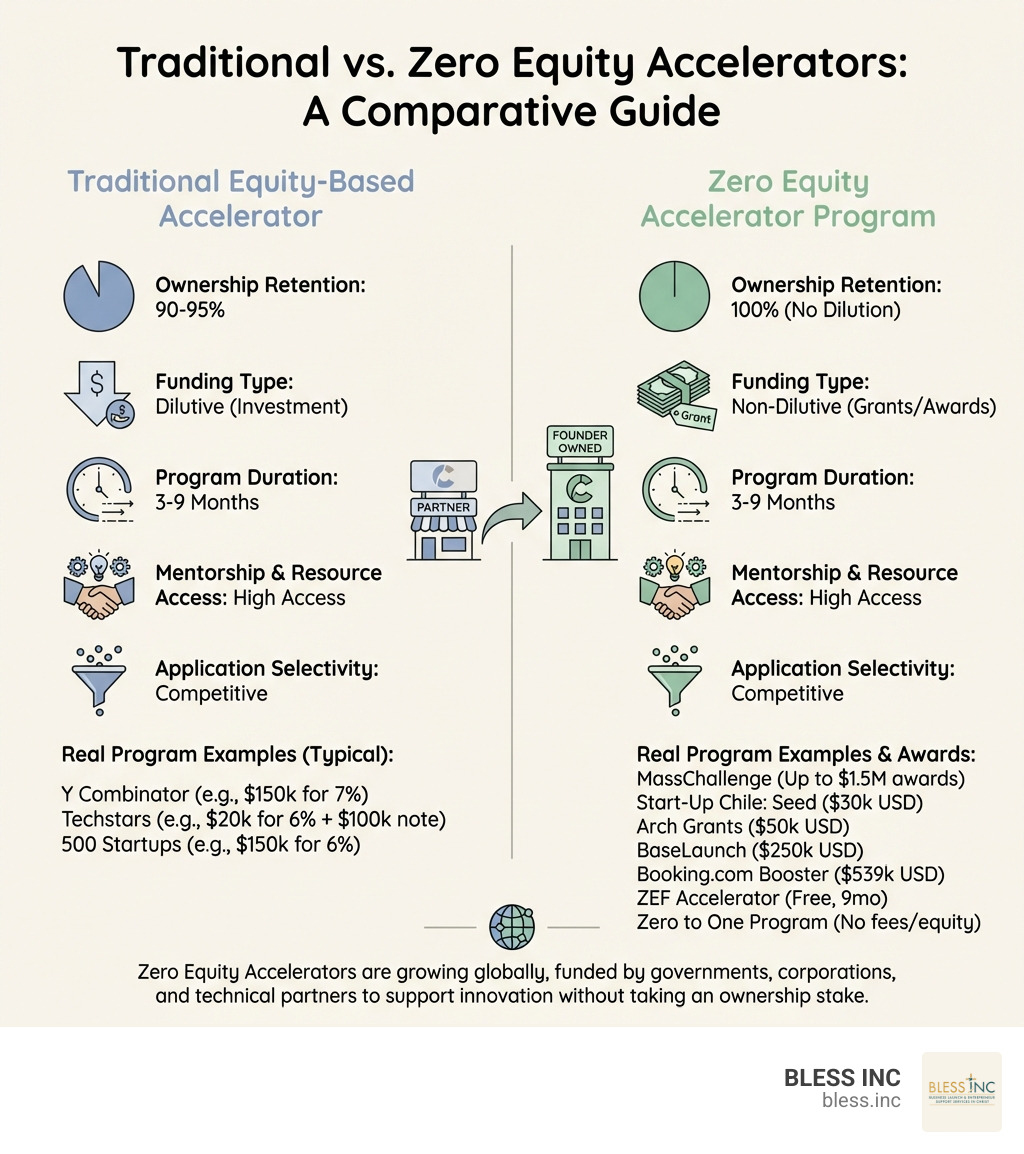
At its core, a zero equity accelerator program is an intensive business support initiative designed to speed up the growth of early-stage companies without requiring an ownership stake in return. While a traditional accelerator usually operates on an “equity-for-capital” model—taking a slice of your company in exchange for a small cash injection—zero equity models prioritize founder autonomy.
These programs are often funded by government grants, corporate social responsibility (CSR) budgets, or technical partners looking to build long-term relationships. For example, some technical partners offer specialized programs where they provide full development support for a single selected founder per cycle, covering all development costs without taking equity.
Ownership Retention and Non-Dilutive Grants
The most significant differentiator is how you handle your cap table. In a zero equity environment, you retain 100% ownership. Instead of selling shares, you might receive “non-dilutive” funding. This can come in the form of:
- Cash Awards: High-stakes competitions where top performers win prizes (sometimes exceeding $1 million in specific regional hubs).
- Stipends: Monthly payments to cover living costs so you can focus entirely on your build.
- Prototype Grants: Specific funds (sometimes around $2,000) dedicated to moving from a concept to a physical or digital product.
Mentorship and Technical Partnership
Beyond the money, these programs provide high-level mentorship and technical resources. You aren’t just getting a check; you’re getting a seat at the table with industry experts. Many programs offer 1-to-1 coaching and access to global networks of investors and corporate partners. This accelerator original approach ensures that even without an equity stake, the program is deeply invested in your success because your growth serves as a case study for their effectiveness.
| Feature | Traditional Accelerator | Zero Equity Accelerator |
|---|---|---|
| Equity Taken | Typically 5% – 10% | 0% |
| Funding Source | Venture Capital / Private Equity | Government / Corporate / Grants |
| Primary Goal | Return on Investment (ROI) | Ecosystem Growth / Innovation |
| Ownership | Diluted | 100% Retained |
| Cost to Founder | High (Long-term value of equity) | Low to None |

Key Benefits of a Zero Equity Accelerator Program
Why do founders choose these programs? It isn’t just about the “free” money. The benefits extend into the very DNA of your startup’s future.
- Full Ownership and Control: You make the decisions. You don’t have a new “boss” on your board of directors who is only looking at the next exit. This is vital for mission-driven or faith-driven entrepreneurs who want to ensure their values remain the core of the company.
- Market Validation: Being selected for a highly competitive program is a massive signal to the market. Various university-based entrepreneurship centers offer intensive programs that help aspiring entrepreneurs turn ideas into sustainable ventures.
- Mentorship Value: Statistics show that 92% of participants in specialized accelerators found mentorship crucial for refining their business strategies. This guidance helps you accelerate growth by avoiding common pitfalls that sink early-stage startups.
- Investor Readiness: Even though the program doesn’t take equity, they prepare you for those who will. Approximately 78% of startups that complete top-tier zero equity programs secure follow-on funding within a year. They help you polish your pitch, clean up your financials, and get in front of the right VCs.
- Networking: Joining an accelerator plugs you into a “ready-made” network. About 88% of startups reported a stronger network of industry connections post-program. This includes access to Trade Commissioners for international expansion or corporate sponsors looking for new technology to acquire.
Intellectual Property and Financial Structures
One of the biggest concerns for any founder is: “If I’m not paying with equity, what am I paying with?” Generally, the “cost” is your time and commitment, but you must understand the legal and financial structures involved.
IP Ownership and Licensing
In almost every reputable zero equity accelerator program, you retain 100% of your Intellectual Property (IP). However, you will often sign a “Terms of Participation” agreement. This usually includes a limited, royalty-free license for the accelerator to use your company name, logo, and certain non-confidential media (like photos of you in the program) for their own marketing and “showcase” purposes.
It is also standard for these programs to include a “non-confidentiality” clause regarding general ideas. This means that while your specific code or trade secrets are yours, the general industry knowledge shared in group sessions isn’t protected. This allows for a freer exchange of ideas between peers.
Financial Support Without the Catch
The financial structures of these programs are designed to remove barriers to entry. Many offer accelerate pricing models or are entirely free. Common financial perks include:
- Living Expense Scholarships: Some university-based programs provide over $6,000 for living costs to support up to three team members during the program.
- Prototyping Funds: Grants of around $2,000 are common for hardware or tech-heavy startups to build their first MVP.
- Partner Benefits: Many accelerators provide “perks” like $100,000 in cloud credits (AWS/Azure) or free access to CRM software, which can save a startup thousands in its first year.
Common Non-Dilutive Funding Amounts
Non-dilutive funding varies by program and stage. Early-stage seed grants often start around $30,000 USD, while location-based growth grants can offer $50,000 USD. High-impact global competitions have been known to award prizes exceeding $500,000 USD to help startups scale without equity dilution.
Program Selection and Eligibility
Not every zero equity accelerator program is a fit for every startup. Because these programs don’t take equity, they are often more selective than traditional ones. They want to ensure their resources are going to founders who have a high probability of making a real-world impact.
Sector-Specific Focus
Many programs are narrowing their scope to solve specific global problems:
- Climate Tech: Specialized 9-month programs exist specifically for decarbonization and sustainability startups.
- SaaS and AI: Technical partners often look for “visionary” tech leaders. If you have a bold idea but lack the dev team, you might Apply Now for Technical Partnership to build and launch your product with a world-class team.
- International Growth: Some programs focus entirely on market-entry strategies and connecting you with Trade Commissioners.
The “Up-or-Out” Model
Some modern programs use an “up-or-out” progression system. This means that while the program might be free to join, your ability to stay in the program and reach graduation depends on your demonstrated progress and participation. It keeps founders accountable. If you aren’t hitting your milestones, you lose your spot to someone who will.
Eligibility and Deadlines
Most programs require you to have at least a “Minimum Viable Product” (MVP) or a very strong business case. For instance, a zero-equity-accelerator might look for founders who are ready to scale their operations rather than those who just have a “napkin sketch” idea.
- Geography: Some grants require you to relocate to a specific city for a year to foster local economic growth.
- Stage: Some are “pre-accelerators” for students, while others are for “scale-ups” generating revenue.
- Deadlines: These are usually firm. Many top-tier programs typically open applications in the first quarter of the year and close them by spring.
Finding the Right Zero Equity Accelerator Program
Choosing the right program is like choosing a co-founder—you need to align on values and goals.
- Strategic Fit: Does the program offer the specific resources you need? If you are a hardware startup, look for programs with specialized prototyping labs. If you need to accelerate scale, look for programs with deep corporate connections.
- Technical Resources: If you are a non-technical founder, a program that provides a technical partner is worth more than a cash grant. Having a team to help you launch can lead to a 70% product launch rate within three months of completion.
- Alumni Success: Look at the track record. Have past graduates raised money? Have they stayed in business? A program with a strong alumni network provides a “warm” path to future investors.
- Tiered Support: Some programs offer different levels of engagement. You might start with a virtual curriculum and move into intensive 1-on-1 mentoring. Checking an accelerator tier comparison can help you see which level of support matches your current bandwidth.
Frequently Asked Questions about Zero Equity Accelerators
Do zero equity accelerators really charge no fees?
Most true zero equity accelerator programs are free. They are funded by sponsors, governments, or partners who benefit from the innovation you bring or the economic growth you create. However, some “boutique” or specialized accelerators may use a “pay-to-play” model or a tiered, sliding-scale fee structure to cover operational costs without taking your shares. Always read the fine print to ensure there are no “hidden” equity warrants or success fees.
How do these programs handle my intellectual property?
You almost always keep 100% of your IP. The program may ask for a limited license to show off your progress in their marketing materials, but the “secret sauce” stays with you. Be aware that in group “pitch” sessions, confidentiality is hard to maintain, so don’t share your most sensitive trade secrets in a room full of other founders.
What are the typical success metrics for graduates?
Success is measured by growth, not just exits. Common metrics include:
- Funding: 78% of graduates secure funding within 12 months.
- Product Launch: 70% launch a new product or service within 3 months of finishing.
- Revenue: Many alumni report significant revenue growth (some hitting $1M+ annual revenue shortly after graduation).
- Jobs: Leading programs track job creation, with alumni creating thousands of new roles in their local ecosystems.
Conclusion
Finding a zero equity accelerator program is one of the smartest moves a founder can make to protect their future. By retaining 100% ownership, you keep the freedom to build your company exactly how you envisioned it—whether that’s scaling to a global IPO or building a sustainable, mission-driven business.
At BLESS INC, we understand that as a founder, you have enough on your plate. You shouldn’t have to choose between getting the support you need and giving away the equity you’ve earned. We provide comprehensive operational support—including finance, HR, tech, and admin—specifically for faith-driven entrepreneurs. Our model is built on Christ-centered compassion and a commitment to helping you succeed while you retain full ownership of your vision.
We offer a zero-equity accelerator environment with tiered, sliding-scale pricing designed to meet you where you are. We handle the “back-office” heavy lifting so you can focus on your calling and your customers.
Start your journey with a Zero Equity Accelerator Program today and see how much faster you can grow when you aren’t held back by dilution or administrative overwhelm. Let us help you build something that lasts, without taking a piece of what’s yours.